Why Your E-Commerce Brand Is the Only Advantage That Can’t Be Copied
A strong branding strategy for e-commerce is the difference between a store people remember and one they forget the moment they close the tab.
Here’s a quick snapshot of what an effective e-commerce branding strategy looks like in 2026:
| Strategy Element | What It Means in Practice |
|---|---|
| Clear Brand Positioning | Define who you’re for and what makes you different |
| Visual Identity System | Consistent logo, colors, and typography across every touchpoint |
| Brand Voice and Storytelling | A distinct tone and narrative that builds emotional connection |
| Omnichannel Consistency | Same look, feel, and message on web, email, social, and mobile |
| AI-Powered Personalization | Relevant product recommendations and content based on real behavior |
| Loyalty and Advocacy | Programs and experiences that turn buyers into repeat customers |
| Data-Driven Iteration | First-party data and metrics that guide brand decisions over time |
Every e-commerce category today is crowded. Thousands of stores sell similar products at similar prices with similar-looking websites. In that environment, your brand is often the only thing competitors can’t replicate overnight.
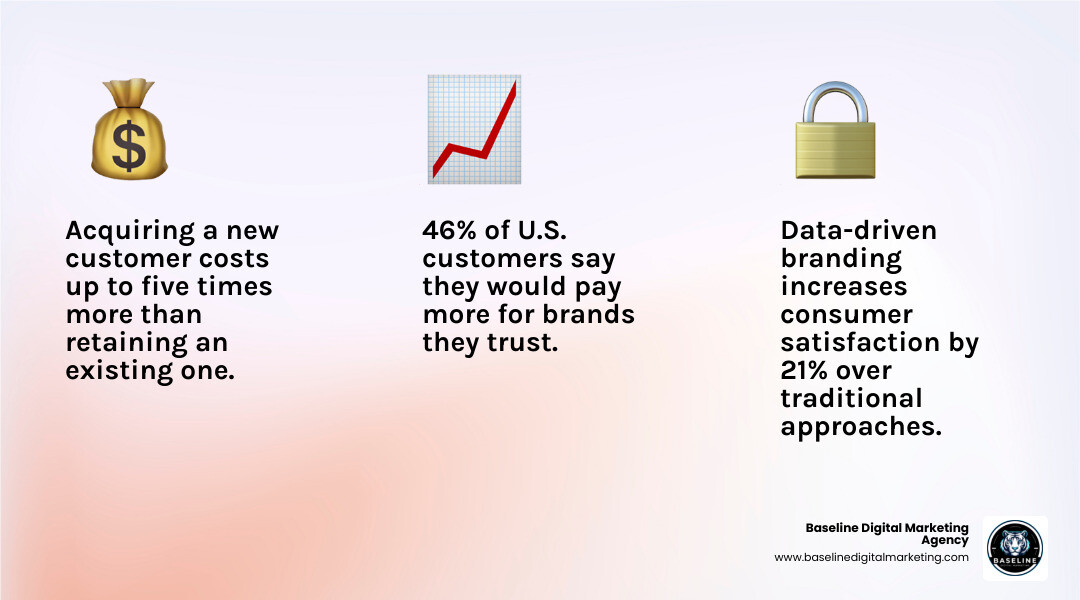
The stakes are real. Research shows that 46% of U.S. customers say they’d pay more for brands they trust — and acquiring a new customer costs up to five times more than keeping an existing one. Strong branding directly affects both of those numbers.
This isn’t just about having a nice logo. It’s about building a perception — one that earns trust, drives repeat purchases, and creates customers who tell their friends.
I’m Carlos Alvarez, founder and CEO of Baseline Digital Marketing, and I’ve helped businesses across industries develop and execute branding strategies for e-commerce that drive measurable growth. In this guide, I’ll walk you through exactly how to build one that works in 2026.
Why a Branding Strategy for E-commerce is Your Best Financial Asset
Many founders think of branding as a “nice-to-have” creative exercise. In reality, it is a high-yield financial asset. In the digital economy of 2026, where privacy regulations have made traditional tracking harder, your brand is the primary driver of capital efficiency.
A New marketing strategy model of E-commerce enterprises suggests that data-driven, personalized branding increases consumer satisfaction by 21% compared to traditional models. When you invest in a professional brand strategy, you aren’t just buying a logo; you’re building “commercial infrastructure” that protects your margins.
Reducing CAC through Organic Brand Recall
Customer Acquisition Cost (CAC) is the silent killer of e-commerce businesses. If you rely solely on paid ads, you are essentially renting your customers from tech giants. A robust branding strategy for e-commerce creates “organic gravity.”
When customers recognize and trust your brand, they search for you by name. This reduces your reliance on expensive keywords. Furthermore, strong brands benefit from referral loops. If your brand experience is distinctive, your customers become an unpaid sales force, significantly boosting your lead generation efforts through word-of-mouth. Brand equity compounds over time, meaning the $1 you spend on marketing today will work twice as hard three years from now because it’s building on a foundation of recognition.
Increasing LTV with Emotional Connections
The real profit in e-commerce isn’t made on the first sale; it’s made on the third, fourth, and fifth. Customer Lifetime Value (LTV) is directly tied to emotional connection. Statistics show that 76% of consumers are more likely to buy from brands they feel emotionally connected to.
By following a guide for e-commerce growth, businesses can learn to move beyond transactional relationships. When a customer trusts your brand, they are 52% more valuable to your business. This trust allows for “trust-based pricing,” where you no longer have to engage in a race-to-the-bottom price war with competitors.
The Core Pillars of a 2026 Branding Strategy
Building a brand in 2026 requires more than just a “vibe.” It requires a structured framework. Think of your brand as an operating system that dictates how your company scales and maintains quality.
To build an e-commerce brand that stands out, you must first define your Unique Value Proposition (UVP). This is your “spiky point of view”—a stance that might even repel the wrong customers while magnetically attracting the right ones.

Developing a Visual Identity and Voice
Your visual identity is the “curb appeal” of your business. When over 70% of e-commerce traffic comes from mobile devices, your visuals must be “thumb-friendly” and instantly recognizable.
- Logo Systems: You need a responsive logo system—primary, secondary, and a simplified icon for small screens.
- Color Psychology: Colors aren’t just for show. Premium brands often use monochrome or restrained palettes, while playful brands lean into saturated primaries.
- Brand Voice: Are you the helpful expert or the rebellious disruptor? Your voice should be consistent whether it’s in a product description or a Search Everywhere Optimization strategy.
Mastering Storytelling in Your Branding Strategy for E-commerce
Storytelling is the bridge between a product and a person. The strongest brands are often built before a single product ever goes live. They start with a narrative: Who is the hero (the customer)? What is the villain (their problem)? And how are you the guide (the solution)?
Authenticity is the currency of 2026. 86% of shoppers seek authenticity when choosing which brands to support. Don’t just tell people what you sell; tell them why it exists. Whether you are in finance, healthcare, or hospitality, a compelling narrative creates a “reason to believe” that goes beyond technical specs.
Implementing a Data-Driven Branding Strategy for E-commerce
In 2026, branding is as much about data as it is about design. A unified data foundation allows you to understand your customer personas at a granular level. By integrating your e-commerce platform with a single source of truth, you can ensure that your brand message evolves based on actual buyer behavior rather than guesswork.
Omnichannel Consistency and the AI Personalization Gap
The modern shopper is everywhere at once. 71% of customers use multiple channels when shopping, yet 55% feel that brands are inconsistent across those channels. This “consistency gap” is where many brands lose trust.
| Feature | Generic Experience | AI-Personalized Experience (2026) |
|---|---|---|
| Product Recommendations | “Customers also bought…” (Static) | Predictive suggestions based on browse/purchase history |
| Email Content | Weekly newsletter (Batch and Blast) | Behavioral triggers (e.g., “We noticed you liked…”) |
| Mobile UX | Scaled-down desktop site | App-like, mobile-first navigation with biometrics |
| Customer Support | “We’ll get back to you in 24 hours” | Instant, brand-voiced AI assistants with full history |
Maintaining Consistency Across Touchpoints
Consistency increases revenue by up to 23%. Your Email & SMS marketing should feel like a continuation of the conversation started on your Instagram. If your social media is witty and edgy, but your customer service emails are stiff and formal, you’re giving your customers “tone whiplash.”
Using AI to Enhance Brand Perception
AI is the “important engine” of 2026 e-commerce. 60% of marketers have seen increased engagement since adopting AI. However, there is a “personalization paradox”: 79% of marketers use AI, but only 25% of consumers feel they are getting the content they actually want.
The key is location-based marketing and behavioral triggers that feel helpful, not creepy. Use AI to handle the “timing” decisions—when to send an email or show an ad—so your brand always appears at the moment of highest relevance.
Amplifying Brand Awareness and Advocacy
Once your foundation is set, you need to turn up the volume. In 2026, the most effective way to build awareness is through a mix of social media marketing and community-driven content.

Turning Buyers into Loyal Brand Advocates
The unboxing experience is the most intimate touchpoint in e-commerce. It’s the only 100% open-rate “marketing channel” you have. Branded tissue paper, handwritten notes (which can increase reviews by 25%), and thoughtful inserts turn a transaction into a shareable event.
Don’t forget the power of free shipping—93% of shoppers buy more when it’s an option. Use this as a brand lever: “You’re only $10 away from free shipping!” creates a sense of FOMO that drives higher order values while making the customer feel they are getting a “deal.”
Measuring the Impact of Branding Efforts
You can’t manage what you don’t measure. While ROI is the ultimate goal, branding requires looking at “leading indicators”:
- Direct Traffic: How many people type your URL directly into their browser?
- Brand Search Volume: Are more people searching for “[Your Brand] Shoes” instead of just “Shoes”?
- Net Promoter Score (NPS): How likely are customers to recommend you?
- Repeat Purchase Rate: Is your brand “sticky”? (The benchmark for top brands is 28-35%).
Frequently Asked Questions about E-commerce Branding
What are the most common branding pitfalls to avoid?
The biggest mistake is homogeneity—trying to look and sound like everyone else. If you copy a competitor, you’ll always be a second-rate version of them. Other pitfalls include broad targeting (trying to be for everyone and ending up being for no one) and inconsistent messaging across different channels.
How does strong branding reduce customer acquisition costs?
Strong branding builds trust before the click. When a user sees your ad, they are more likely to click (higher CTR) and more likely to buy (higher conversion rate) because they recognize your name. This efficiency lowers your total spend per customer.
How can brands maintain consistency across omnichannel touchpoints?
The secret is a centralized Brand Style Guide and a unified data foundation. Every team member—from the social media manager to the customer service rep—should have access to the same voice guidelines, visual assets, and customer history.
Conclusion
In the competitive landscape of 2026, a branding strategy for e-commerce isn’t just about aesthetics—it’s about survival and scale. At Baseline Digital Marketing Agency, we specialize in helping businesses bridge the gap between “just another store” and a “household name.”
Whether you need a full Branding Studio experience or a data-driven SEO strategy, we are here to help you build a brand that lasts. Ready to turn your e-commerce store into an unforgettable brand? Contact us today and let’s get started.