What Is a Website Redesign — and Why It Matters
A website redesign is the process of transforming your site’s structure, content, design, and functionality to better serve your business goals and your users’ needs.
If you’re trying to figure out where to start, here’s a quick overview:
| Question | Quick Answer |
|---|---|
| What is it? | A full rebuild of your site’s structure, design, and content |
| When do you need one? | Every 18–30 months, or when traffic/conversions are dropping |
| How long does it take? | 8 weeks (fast track) to 6 months (full agency project) |
| What does it cost? | Roughly $2,000–$50,000+ depending on scope |
| Will it hurt SEO? | Temporarily, if not done carefully — but long-term it helps |
| What’s the biggest benefit? | Better user experience, more leads, stronger brand credibility |
Your website is often the first thing a potential customer sees. And the stakes are high — 75% of users judge a company’s credibility based on its website design alone. An outdated or slow site doesn’t just look bad. It actively costs you business.
The good news? A well-planned redesign fixes that — and then some.
I’m Carlos Alvarez, founder and CEO of Baseline Digital Marketing, and I’ve helped businesses across industries transform their online presence through strategic website redesign projects that drive real, measurable growth. In this guide, I’ll walk you through everything you need to know — from warning signs to launch day — so you can make confident decisions for your business.
Why a Website Redesign Is a Strategic Must-Have in 2026
In May 2026, the digital landscape is moving faster than ever. What worked online three years ago now feels like ancient history. The way users interact with businesses has fundamentally shifted, and your virtual storefront needs to keep pace.
A website redesign is not just a superficial beauty treatment; it is a vital business pivot. When your online home becomes cluttered, slow, or misaligned with your current offerings, it actively pushes potential customers into the open arms of your competitors. Because 75% of users judge a company’s entire credibility on how their website looks and feels, an outdated layout is equivalent to a physical shop with cracked windows and a squeaky door.
To maintain a competitive edge, industry leaders typically refresh their website design every 18 to 30 months. This timeline ensures that your technology remains secure, your visual language stays modern, and your user experience (UX) meets the latest accessibility standards. If you wait five years to update your site, you aren’t just falling behind—you are starting from scratch while your competitors continue to optimize.
As explored in the industry analysis A website redesign in 2026: growth or risk? – GAIA Digital , undertaking a structural overhaul comes with both massive opportunities for growth and calculated risks that must be managed. When executed strategically, a redesign functions as a powerful engine for business growth, solidifying your brand authority and scaling your lead-generation efforts.
Website Redesign vs. Website Refresh: Key Differences
Many business owners use the terms “redesign” and “refresh” interchangeably, but they represent entirely different scopes of work, budgets, and strategic outcomes.
A website refresh is a cosmetic update. Think of it like putting a fresh coat of paint on your walls, swapping out a few outdated photos, and updating your typography. The underlying code, page structure, navigation, and core functionality remain exactly the same. It is a quick, cost-effective way to align your site with a minor brand update.
A website redesign, on the other hand, is an architectural transformation. This is a complete rebuild where we tear down the old framework and build a modern, high-performing asset from the ground up. We restructure the information architecture, completely rewrite and optimize the content, overhaul the navigation paths, and introduce new functional elements (like interactive forms, custom portals, or advanced e-commerce checkout flows).
To help you decide which path is right for your business, here is a direct comparison:
| Feature | Website Refresh | Website Redesign |
|---|---|---|
| Primary Focus | Visual aesthetics and minor content updates | Structural architecture, UX, and strategic alignment |
| Codebase | Retains existing code and CMS setup | Often involves clean, modern code or a new platform |
| Navigation & Flow | Remains identical | Completely restructured for intuitive user journeys |
| SEO Impact | Minimal risk and minimal immediate reward | High risk if unmanaged; massive long-term ranking gains |
| Timeline | Typically 1 to 3 weeks | 2 to 6 months depending on complexity |
| Best For | Modernizing a site that already performs well | Fixing poor conversion rates and outdated technology |
The Business Benefits of a Strategic Redesign
When you treat your website as an active member of your sales team, the financial benefits of a website redesign quickly become clear.
First and foremost is the exponential impact of professional user experience (UX) design. Industry data shows that every $1 invested in UX results in a return of $100—a staggering 99% ROI. By focusing on how users navigate your pages, removing friction points, and presenting clear calls to action, you transform casual visitors into paying customers.
Additionally, a strategic redesign delivers:
- Improved Conversion Rates: By streamlining user journeys and designing intuitive conversion funnels, we turn passive traffic into qualified leads.
- Elevated Brand Perception: Your website will finally match the real-world quality of your services, positioning you as a forward-thinking leader in your industry.
- Seamless Mobile Responsiveness: With a layout designed to adapt perfectly to every screen size, you capture the modern buyer on the go.
If you want to see how we translate these principles into stunning, high-converting digital assets, take a look at our Portfolio and explore our dedicated work in Web Design.
Key Warning Signs: When Is It Time to Redesign?
How do you know if your website is quietly hurting your business? Websites rarely crash all at once; instead, they slowly degrade in performance, leaking leads and search rankings over time.
Here are the critical warning signs that it is time to plan a complete overhaul:
- Your Website Looks Outdated: Visual trends change. If your layout features clunky sidebars, tiny fonts, or a cluttered homepage, users will immediately sense that your business is behind the times.
- Poor Mobile Performance: Over 60% of global web traffic now originates from mobile devices, and Google ranks websites on a mobile-first index. If your desktop site is simply “shrunk down” for mobile, or if buttons are too small to tap, you are alienating more than half of your potential audience.
- Slow Load Times: In 2026, user patience is at an all-time low. A single-second delay in page load time can slash conversions by 20%. Even worse, over 70% of visitors will completely abandon your website if it takes longer than 3 seconds to load.
- Declining Traffic and Engagement: If your Google Analytics dashboard shows a steady drop in organic traffic, skyrocketing bounce rates, and a decrease in time-on-site, your content and structure are failing to engage your visitors.
- Security Vulnerabilities: Outdated plugins, legacy content management systems, and messy code make your site a prime target for hackers. A modern site must be secure, compliant, and built on a stable foundation.
Even public institutions are recognizing the urgent need to modernize outdated digital infrastructures to meet modern user expectations, as highlighted in The Big Redesign: What’s Next for Government Websites? – GovTech . If government portals are prioritizing streamlined navigation and fast load times, your commercial business cannot afford to fall behind.
Planning Your Strategy: Goals, Questions, and User Research
A beautiful website that fails to solve your business challenges is an expensive failure. That is why we never start a website redesign by picking out color palettes or playing with fonts. We start with strategy.
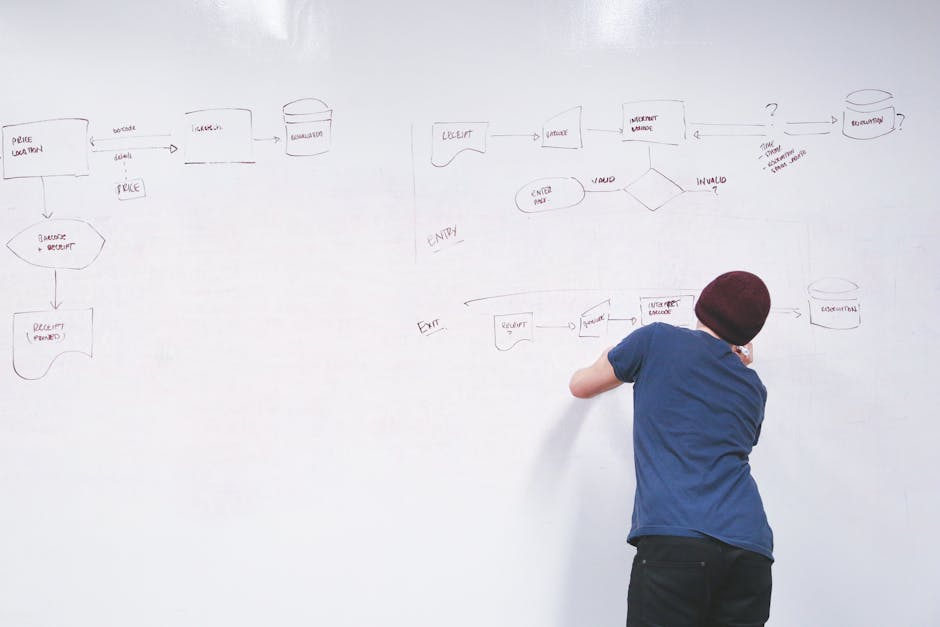
The discovery and research phase is the most critical part of the entire project. During this step, we conduct a comprehensive website audit to evaluate your existing technical performance, analyze user behavior through heatmaps, and identify where visitors are dropping off. We also perform a thorough competitor review to see what is working in your industry and where you can carve out a unique visual and functional advantage.
By mapping out key user activities and interactions, we create intuitive paths that guide users effortlessly from their initial landing page to a completed inquiry or purchase.
Key Questions to Ask Before You Begin
Before writing a single line of code, sit down with your team and answer these five fundamental questions:
- What is the main goal of the redesign? Are you trying to generate more inbound leads, support a brand repositioning, improve online sales, or make it easier for your team to update content?
- Who is actually using your site, and what do they want? Who is your ideal customer? What pain points are they trying to solve when they land on your homepage?
- Where is the current site falling short? Is the navigation confusing? Is the messaging unclear? Are users getting stuck on a complicated checkout form?
- How should your brand show up visually and in your messaging? Does your current site reflect who you are today, or are you still showcasing services and values from five years ago?
- What does success look like in six months? Define real, trackable key performance indicators (KPIs) such as a 25% increase in conversion rates, faster page speeds, or higher search rankings for core keywords.
The Phases of a Successful Redesign Process
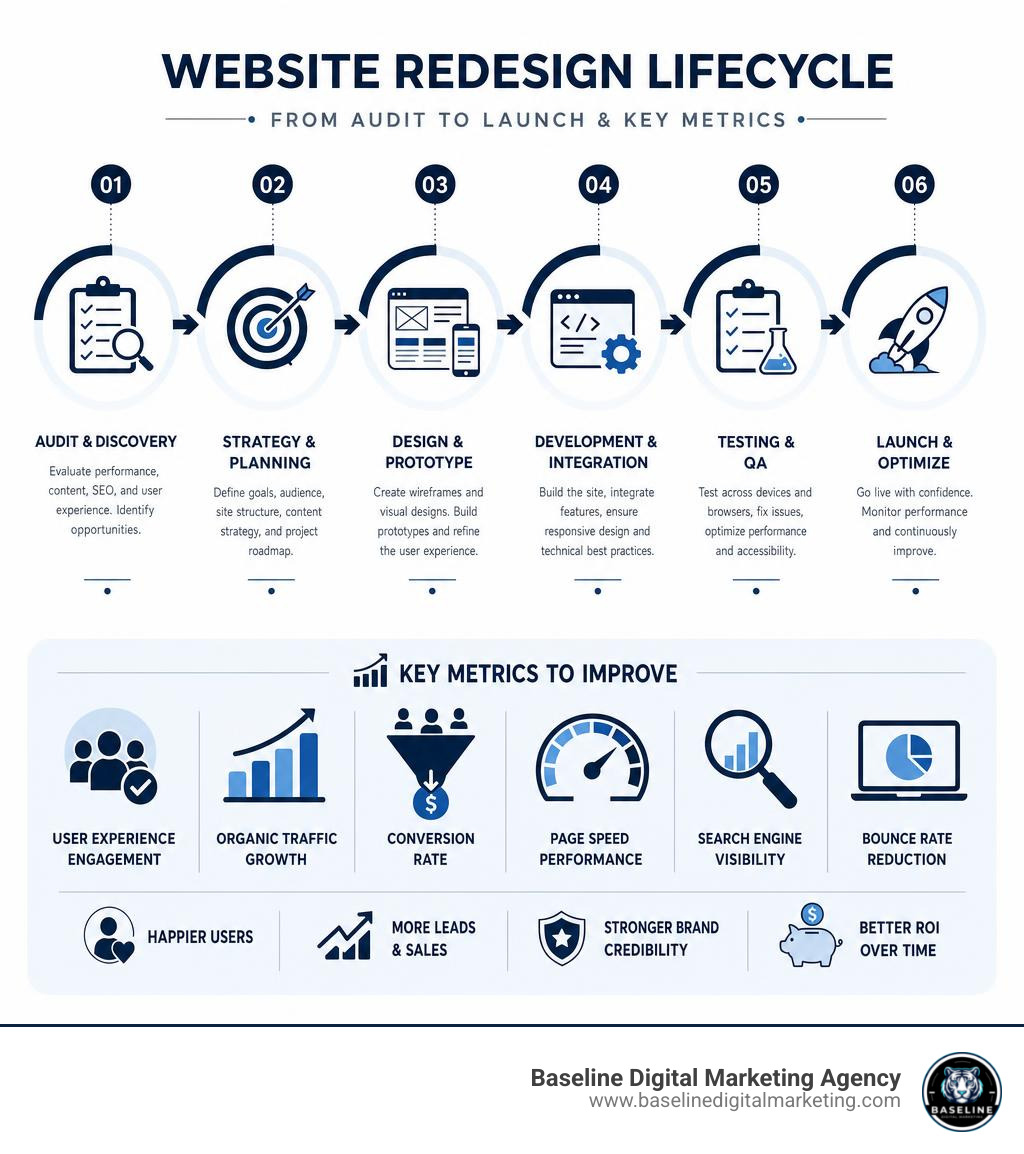
At Baseline Digital Marketing Agency, we believe in a structured, transparent process that eliminates guesswork and keeps your project moving forward smoothly. A successful website redesign consists of five distinct phases:
[Discovery & Audit] [Information Architecture] [Custom Design] [Custom Development] [Launch & Support]
- Discovery and Strategy: We audit your existing site, research your competitors, and define your target audience and core business goals.
- Information Architecture (IA) & Wireframing: We map out the menu structure, page hierarchies, and create black-and-white wireframes to establish layout and user flow without getting distracted by visual design.
- Custom Design: Our design team brings your brand to life, crafting high-fidelity mockups of your unique visual identity, including custom graphics, typography, and interactive elements.
- Custom Development & Optimization: We turn those static designs into clean, responsive, and search-engine-optimized code. We build on user-friendly content management systems so your team can easily update text and images in the future.
- Launch Management & Testing: We test every link, form, browser compatibility, and speed metric before safely deploying your new site to the live server.
If you are looking for a team to handle this complex process from start to finish with expert precision, explore our comprehensive Website Development services.
Preserving SEO Rankings During a Website Redesign
One of the biggest fears business owners have when redesigning their website is losing their hard-earned Google rankings. It is a valid concern—a poorly handled migration can destroy your organic search visibility overnight.
To protect your SEO equity, we implement a strict migration checklist:
- Map 301 Redirects: We identify every high-performing URL on your old site and map it directly to its corresponding page on the new site. This ensures that search engines and users never hit a dead-end 404 error page.
- Preserve Metadata: We keep your existing, high-ranking meta titles, descriptions, and header structures intact unless a strategic change is required.
- Maintain Clean, Semantic HTML: We write search-engine-friendly code that makes it incredibly easy for Google’s crawlers to read, index, and rank your content.
- Keep Keyword-Rich Content: While updating copy is great, we ensure that your core keywords and high-performing informational content remain structurally sound.
The Role of AI in Modern Web Design
AI has completely transformed the way we approach digital creation. Today, AI-powered tools are incredibly valuable for rapid prototyping, generating design inspiration, and automating repetitive front-end coding tasks—often reducing manual front-end development hours by up to 60%.
However, while AI is a fantastic assistant, it has clear limitations. AI tools lack the human-centric understanding required to build a deeply strategic, brand-aligned website. An AI can generate a generic layout in minutes, but it cannot sit down with you to understand your unique business culture, empathize with your customers’ emotional drivers, or write the high-converting, nuanced copy that builds real trust.
As discussed in the video [Web Design Is About to Change Forever (and nobody even realises) ], the integration of AI tools requires a balanced approach. The future of web design belongs to human designers who use AI to handle repetitive tasks, freeing up their time to focus on strategic, creative, and highly customized solutions that truly move the needle for your business.
Measuring Success: Key Metrics That Matter
Once your beautiful new website is live, the work is not finished. Now, it is time to measure your return on investment.
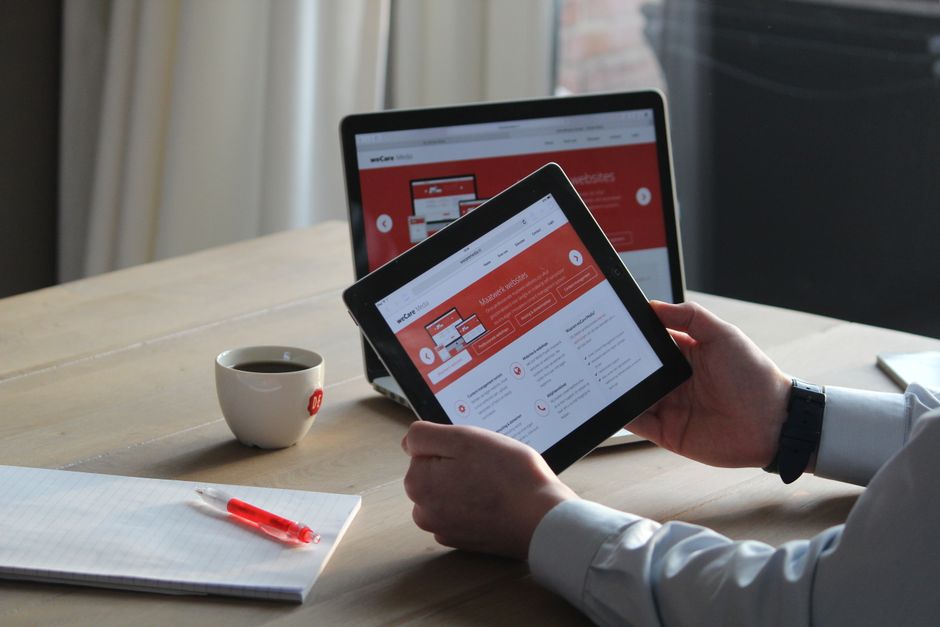
To determine if your website redesign was a success, you must track these core performance metrics over the next six months:
- User Engagement: Monitor your bounce rate, average session duration, and pages per session. If users are staying longer and exploring more pages, your new UX is doing its job.
- Conversion Metrics: Track the percentage of visitors who take a desired action, such as filling out a contact form, calling your business, downloading a resource, or making a purchase.
- SEO and Organic Performance: Watch your search rankings, organic impressions, and click-through rates (CTR) in Google Search Console to ensure your traffic is growing.
- Technical Performance (Core Web Vitals): Measure your page load speeds, mobile usability scores, and interactive stability to ensure a flawless experience across all devices.
Frequently Asked Questions about Website Redesign
How long does a website redesign typically take?
A standard, high-quality agency redesign typically takes anywhere from 3 to 6 months. This timeline allows for thorough discovery, custom UI/UX design, development, content creation, and rigorous testing. For growth-stage businesses facing tight deadlines (such as an upcoming fundraising round or a major brand pivot), we can often execute a fast-track redesign in about 8 weeks without compromising on strategy or build quality.
How much does a professional website redesign cost?
The cost of a professional website redesign depends entirely on the size, complexity, and unique functional requirements of your business. A simple structural cleanup and visual tuning for a small local business can range from $2,000 to $5,000. For mid-sized companies requiring custom layouts, specialized integrations, and comprehensive SEO migrations, projects typically range from $10,000 to $30,000. Large enterprise websites with complex e-commerce or custom databases can go upward of $50,000.
Will a redesign temporarily hurt my search engine rankings?
It is completely normal to see minor, temporary fluctuations in your search engine rankings for a few weeks immediately following a launch as Google crawls and indexes your new site structure. However, by strictly following a professional SEO migration process—including mapping 301 redirects, preserving meta tags, and maintaining keyword-rich content structures—these fluctuations will be minimal, paving the way for massive long-term organic growth.
Conclusion
Your website is the digital face of your business. If it is slow, outdated, or confusing, it is quietly turning potential clients away. A strategic, professionally executed website redesign is one of the most powerful investments you can make to drive business growth, build lasting credibility, and turn casual traffic into loyal customers.
At Baseline Digital Marketing Agency, we combine deep strategic planning, cutting-edge technical expertise, and human-centric design to transform underperforming websites into high-yielding business assets. Whether you need an architectural reset, custom development, or a complete brand transformation, we are here to guide you every step of the way.
Ready to elevate your digital presence and start winning more clients online? Explore our full suite of Services across various Industries, check out our work in Creative Website Design, and contact us today to partner with us for your next Website Development project. Let’s build something remarkable together!