Social Media Marketing in 2026: What It Is and Why It Matters
Social media marketing is the practice of using platforms like Facebook, Instagram, TikTok, YouTube, and LinkedIn to build your brand, reach new customers, and grow your business — through a mix of organic content, paid ads, community engagement, and influencer partnerships.
Here is a quick-reference summary:
| What | Social media marketing (SMM) |
|---|---|
| Goal | Build brand awareness, generate leads, drive sales |
| How | Organic content, paid ads, influencer partnerships, community management |
| Top platforms | Facebook, Instagram, TikTok, YouTube, LinkedIn |
| Who uses it | Businesses of all sizes, from solo founders to global brands |
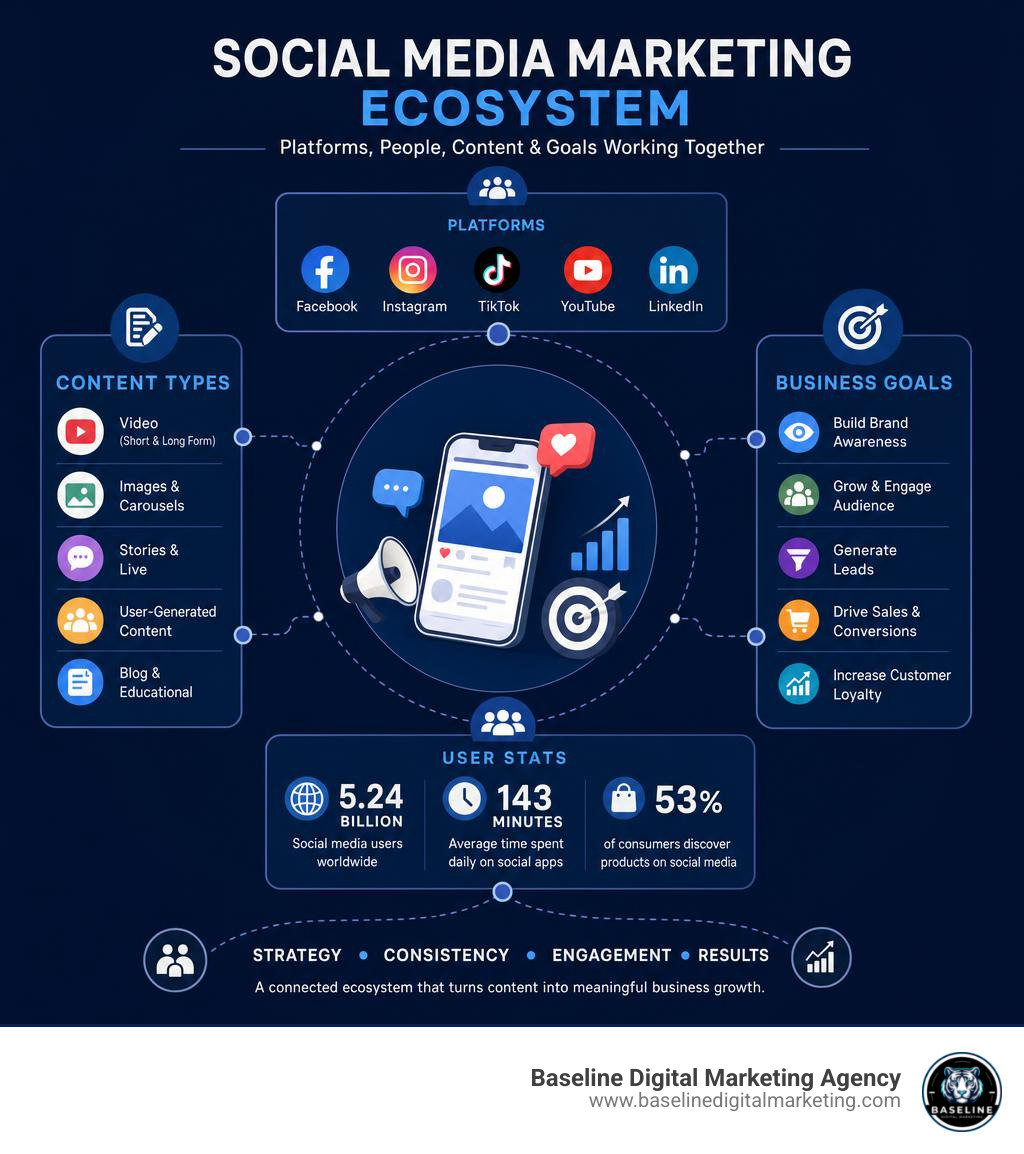
| Why it works | 5.24 billion users spend an average of 143 minutes per day on social apps |
| Key stat | 53% of consumers now discover products on social media |
The numbers behind social media are hard to ignore. There are now 5.24 billion social media users worldwide, and the typical person uses nearly 7 different platforms every month. Meanwhile, social media advertising spend hit $276.7 billion globally in 2025 — that is 3 out of every 10 dollars spent on digital advertising.
For small businesses especially, the opportunity is enormous. Social media levels the playing field. A well-executed post from a local brand can outperform a big-budget campaign from a Fortune 500 company — if the strategy is right.
But most small business owners are stuck. They are posting inconsistently, guessing at what works, and seeing little return. That is exactly what this guide is here to fix.
My name is Carlos Alvarez, founder and CEO of Baseline Digital Marketing Agency, and I have built my career around helping businesses grow through smart digital strategies — including social media marketing. In the sections ahead, I will walk you through everything you need to know to turn social media into a real growth channel for your business.
What is Social Media Marketing and How Does It Work?
To truly succeed online today, we must first understand that social media marketing (SMM) is not just a digital version of a highway billboard. Traditional marketing is a one-way street: a brand buys an ad, broadcasts a message, and hopes someone buys. It is loud, disruptive, and increasingly ignored by modern consumers.
SMM, on the other hand, is a two-way dialogue. It is built on three core pillars that traditional marketing simply cannot match:
- Connection: We can reach customers where they already spend their time. Over 80% of consumers use the web to research products and services before making a purchase. Social media allows us to meet them at the very beginning of that journey.
- Interaction: Instead of shouting at an audience, we can talk with them. Social media gives brands the unique opportunity to build genuine relationships through comments, direct messages, and shared experiences.
- Customer Data: SMM tools allow us to transform “big data” into actionable market analysis. We can see exactly who is engaging with our brand, what they care about, and how they behave, allowing us to refine our approach in real time.
At Baseline Digital Marketing Agency, we view social media as a connected system designed to drive commercial revenue. It is not about chasing vanity metrics like “likes” that do not pay the bills. It is about building an authentic presence that moves people from casual followers to loyal, paying customers. If you want to see how this fits into a broader growth plan, explore our full suite of Social Media Marketing services.
Active vs. Passive Social Media Marketing
When we design an SMM strategy, we utilize two distinct approaches: active and passive. A healthy marketing system requires a balance of both.
- The Active Approach: This is the proactive side of marketing. It involves creating and publishing original content, launching targeted ad campaigns, partnering with creators, and actively reaching out to your community. This approach is designed to create “buzz,” drive immediate traffic, and directly promote your products or services.
- The Passive Approach: This is the analytical, listening-focused side of marketing. Instead of broadcasting, we use social media as a tool for market intelligence. By tapping into blogs, content communities, forums, and social listening tools, we can monitor what people are saying about our brand, our competitors, and our industry.
By analyzing this “social chatter,” we gain invaluable insights. We can resolve customer service issues before they escalate, identify gaps in the market, and learn exactly what our target audience wants. To dive deeper into how modern brands balance these approaches, check out Your Complete Guide to Social Media Marketing in 2026.
The Core Pillars of Social Media Marketing
To make social media work for your business, you must stop thinking in terms of individual posts and start thinking in terms of systems.
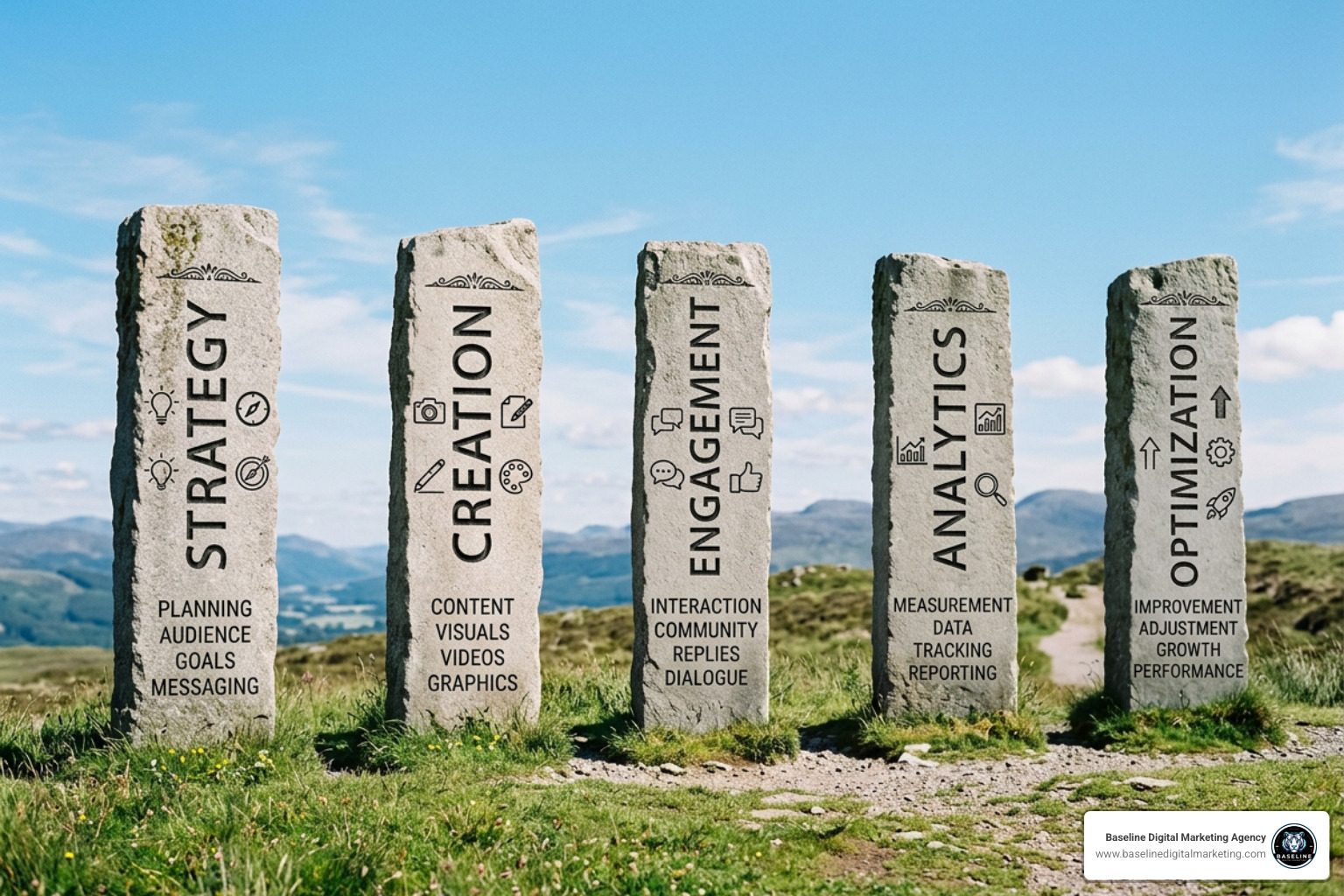
Every successful campaign we run is built on five core pillars:
- Strategy: Before you publish a single post, you must define your commercial goals. Are you trying to build brand awareness, generate leads, or drive direct sales? Your business objective dictates your content format.
- Planning and Publishing: Consistency is key. We help brands map out their content in advance using structured calendars, ensuring that every post serves a specific purpose and aligns with their brand voice.
- Listening and Engagement: Social media is an interactive community. Monitoring direct messages, comments, and brand mentions allows us to engage in real-time conversations, humanizing your brand and building trust.
- Analytics and Reporting: We do not guess what works; we look at the data. By tracking reach, engagement, and conversion rates, we can constantly optimize our campaigns for better performance.
- Advertising (Paid Amplification): Organic content is fantastic for nurturing relationships, but paid social ads allow you to scale. Putting budget behind organic posts that are already performing well is the fastest way to accelerate your growth.
By integrating these pillars, we can turn casual online interactions into structured customer journeys. For a deeper look at how to build these relationships, read the insights in Social Media Marketing: Turning Followers Into Customers | Salesforce ANZ.
Key Platforms and 2026 Trends
Not all social networks are created equal. Trying to maintain an active presence on every single platform will quickly burn out your team and dilute your results. Instead, we recommend focusing your energy on the platforms where your target audience is most active.
To help you decide where to invest your resources, let’s look at how the major networks compare in 2026:
| Platform | Monthly Active Users | Dominant Demographics | Top Content Formats | Average Interaction/Engagement Rate |
|---|---|---|---|---|
| 3.07 Billion | Ages 25–45+ | Images, Link Shares, Reels | ~0.05% to 0.15% (Reels perform highest) | |
| 3.00 Billion | Ages 18–34 | Carousels, Reels, Stories | ~1.46% interaction rate | |
| TikTok | 1.60 Billion | Ages 13–29 | Short-Form Video | ~2.5% average engagement rate |
| YouTube | 2.60 Billion | Ages 18–44 | Long & Short-Form Video | High (driven by watch time) |
| 1.10 Billion | Professionals (25–54) | Thought Leadership, PDF Carousels | High for B2B industry niches | |
| X (Twitter) | 210 Million | Ages 25–49 | Short Text, Real-time News | ~0.03% interaction rate |
With the average person spending 143 minutes a day across these channels, the opportunity to capture attention is massive. Let’s break down the distinct roles of the major networks:
- Facebook: Despite being the oldest major network, Facebook remains the world’s most widely used platform. In fact, 89% of organizations still use Facebook for marketing. It is highly effective for local businesses, community groups, and advanced paid advertising campaigns.
- Instagram: Highly visual and commercial. Instagram is a powerhouse for product discovery and brand storytelling. Its carousel posts and Reels drive exceptional interaction rates (averaging 1.46% compared to X’s 0.03%).
- TikTok: The undisputed king of organic reach and engagement. With a 2.5% average engagement rate, TikTok’s algorithm prioritizes the quality of the content over follower count, making it highly accessible for growing brands.
- YouTube: As the world’s second-largest search engine, YouTube is unmatched for in-depth educational content, product demonstrations, and long-term search visibility.
- LinkedIn: Now boasting over 1.1 billion registered users, LinkedIn has evolved from a simple resume database into the ultimate platform for B2B marketing, employee-led storytelling, and professional thought leadership.
The Rise of Short-Form Video and Social Search
If there is one trend dominating the digital landscape in 2026, it is the shift in how consumers find information. TikTok, Instagram, and YouTube now drive over 60% of product discovery, officially surpassing Google for younger demographics.

When Gen Z and Millennial consumers want to find a new restaurant, research a skincare product, or buy a piece of luggage, they do not type a query into a traditional search engine. Instead, they search on social media to watch real people demonstrate the products in real time.
To win in this environment, your business must master short-form video formats like YouTube Shorts, Instagram Reels, and TikToks. Successful creators and brands are using specific psychological frameworks to capture this attention:
- Audio-Visual-Text Hooks: Capturing the viewer’s attention within the first 2 seconds using bold text overlays and dynamic audio.
- Curiosity Loops: Opening a question or showing an exciting result at the start of the video, prompting the viewer to watch until the very end to get the answer.
- Obstacle-Solution Storytelling: Showing a relatable problem and demonstrating how your product or service provides the ultimate solution.
The Role of Influencers and User-Generated Content
Consumers have developed a strong filter against polished, corporate advertising. In 2026, authenticity is the ultimate currency. This is why user-generated content (UGC) and creator partnerships have become so vital.
Rather than hiring expensive celebrity influencers, smart brands are partnering with micro-influencers—creators with smaller, highly dedicated followings (typically between 5,000 and 50,000 followers). These creators have built deep trust with their audiences, resulting in much higher engagement and conversion rates.
Additionally, leveraging UGC as “earned media” allows you to showcase real customers sharing their genuine experiences with your brand. This not only lowers your content production costs but also increases brand accountability. With 81% of consumers agreeing that social media increases brand accountability, showing real, unedited proof of your product’s value is non-negotiable. To learn how to build a scalable creator playbook, take a look at Social Media Marketing for Brands: An Actionable Playbook – JoinBrands.
Executing and Measuring Your Campaigns
To execute successful campaigns, we must first clear up a common point of confusion: the difference between social media management and social media marketing.
- Social Media Management is the execution layer. It involves scheduling posts, responding to comments, organizing assets, and running daily operations. It keeps your channels active and tidy.
- Social Media Marketing is the strategic layer. It is where we define the target audience, set commercial goals, build content pillars, allocate advertising budgets, and analyze performance data to ensure our social efforts are actively growing the business.
To run this system effectively, your team needs a mix of creative skills (copywriting, video editing, graphic design) and analytical skills (data tracking, audience segmentation, budget management). To stay updated on the latest strategic shifts and industry tips, you can explore our team’s regular updates on our Blog.
Building a Successful Social Media Marketing Strategy
If you are ready to build a strategy that moves the needle, we recommend following this step-by-step roadmap:
- Identify Your Target Audience: Do not try to speak to everyone. Build detailed buyer personas based on historical sales data, customer interviews, and demographic insights.
- Set SMART Goals: Ensure your objectives are Specific, Measurable, Achievable, Relevant, and Time-bound. Instead of saying “we want more followers,” aim for “we want to increase website referral traffic from Instagram by 20% over the next quarter.”
- Establish Content Pillars: Define 3 to 5 core topics that your brand will consistently talk about. This keeps your messaging focused and prevents your feed from looking disorganized.
- Create a Content Calendar: Plan your content at least two to four weeks in advance. This ensures a healthy mix of promotional, educational, and entertaining content without the stress of last-minute posting.
- Integrate Organic and Paid Social: Do not rely on organic reach alone. Prospects exposed to both organic and paid social content are 61% more likely to convert. Use organic posts to build community, and use paid ads to scale your reach to new audiences.
Tracking Key Performance Indicators (KPIs)
If your key performance indicators (KPIs) cannot be connected back to a business objective, they are vanity metrics. To understand if your marketing is actually working, you should track metrics across three distinct stages of the customer journey:
- Awareness Metrics: Reach and impressions tell you how many unique eyes are seeing your content.
- Engagement Metrics: Saves, shares, and comments are far more valuable than simple “likes.” They signal to platform algorithms that your content is highly valuable, which helps boost your organic reach.
- Conversion Metrics: Click-through rates, lead generation forms filled, and direct sales tell you if your social media traffic is actually translating into revenue.
Additionally, as you scale your paid advertising campaigns, it is vital to keep compliance in mind. Regulatory bodies are paying closer attention than ever to digital ads, sponsorships, and influencer disclosures. To ensure your campaigns stay fully compliant and protected, listen to the legal insights in the Podcast – Social Media Advertising and the FTC – Holland & Knight.
Frequently Asked Questions about SMM
What is the difference between organic and paid social media?
Organic social media refers to all the free content you post to your profiles (videos, photos, updates). It is excellent for nurturing relationships with your existing followers, building brand personality, and providing customer support. Paid social media involves paying platforms to display ads to highly targeted audiences who may not follow you yet. A healthy hybrid strategy uses organic content to build trust and paid ads to scale traffic and drive direct conversions.
How has social media marketing changed in 2026?
The biggest shift in 2026 is the integration of AI tools for content creation and the rise of “authenticity filters” to help users identify AI-generated media. Because the internet is flooded with automated content, consumers are retreating into private communities, such as closed groups and direct message channels, to find genuine human connection. Additionally, social search has officially redefined product discovery, turning platforms like TikTok and Instagram into highly visual search engines that rival traditional search platforms.
Can a business succeed without social media?
Yes, it is entirely possible to run a highly successful business without social media by focusing on alternative channels like search engine optimization (SEO), email marketing, and community referrals. This is particularly true for multi-location businesses that rely heavily on local search visibility. However, social media remains one of the fastest, most cost-effective ways to build brand trust at scale. For a fascinating look at alternative approaches, check out It’s 2026. It’s Time to Start Marketing Without Social Media..
Conclusion
In 2026, social media marketing is no longer optional—it is the digital front door to your business. But as we have explored in this guide, true success does not come from chasing trends or posting aimlessly. It comes from building a structured, consistent system that aligns your creative content with your commercial goals.
At Baseline Digital Marketing Agency, we specialize in taking the guesswork out of digital growth. We build comprehensive digital strategies, drive organic visibility through advanced SEO, deliver cutting-edge AI automation, design beautiful websites, and craft memorable branding that helps businesses stand out in a crowded digital landscape.
Whether you are looking to build a brand-new social strategy from scratch or optimize your existing campaigns for real revenue, we are here to help. Discover how we can help you scale by visiting our Services page, or let’s start building your custom campaign today with our specialized Social Media Marketing services. Let’s grow your business together!