
Search Has Changed — Here’s What You Need to Know About Generative AI Search Engine Optimization
Generative AI search engine optimization is the practice of making your brand visible and citable in AI-powered search tools like ChatGPT, Google AI Overviews, and Perplexity — not just ranking in traditional Google results.
Quick answer: What is generative AI SEO (GEO)?
| Question | Answer |
|---|---|
| What is it? | Optimizing content so AI search engines cite your brand in their generated answers |
| How is it different from SEO? | SEO targets keyword rankings; GEO targets AI citations and brand mentions |
| Why does it matter? | AI Overviews now appear on ~18% of queries, and clicks drop by nearly half when a summary is present |
| What does it require? | High-quality content, E-E-A-T signals, structured data, and earned media coverage |
| Who needs it? | Any business that relies on search to drive traffic, leads, or sales |
Search is shifting fast. Google’s AI Overviews, ChatGPT, and Perplexity are changing how people find information — and whether they ever click through to your website at all.
When an AI gives a user a complete answer, many people stop there. Research shows that only about 8% of users click a link when an AI summary is present, compared to 15% when it isn’t. For small businesses already struggling to get found online, that gap is a real problem.
And it’s not slowing down. Forrester found that 89% of B2B buyers now use generative AI as part of their purchasing research. Adobe found that 87% of people are more likely to turn to AI for bigger, more complex purchases — exactly the kind of decisions that used to send buyers to your website first.
The rules of search visibility haven’t disappeared. But they have changed.
I’m Carlos Alvarez, founder and CEO of Baseline Digital Marketing — an AI-powered digital marketing agency — and I’ve spent years helping businesses grow through SEO strategy and, more recently, guiding brands through the shift to generative AI search engine optimization. In this guide, I’ll break down exactly what’s changed, what still works, and what you need to do right now to stay visible.
The Shift to Generative AI Search Engine Optimization (GEO)
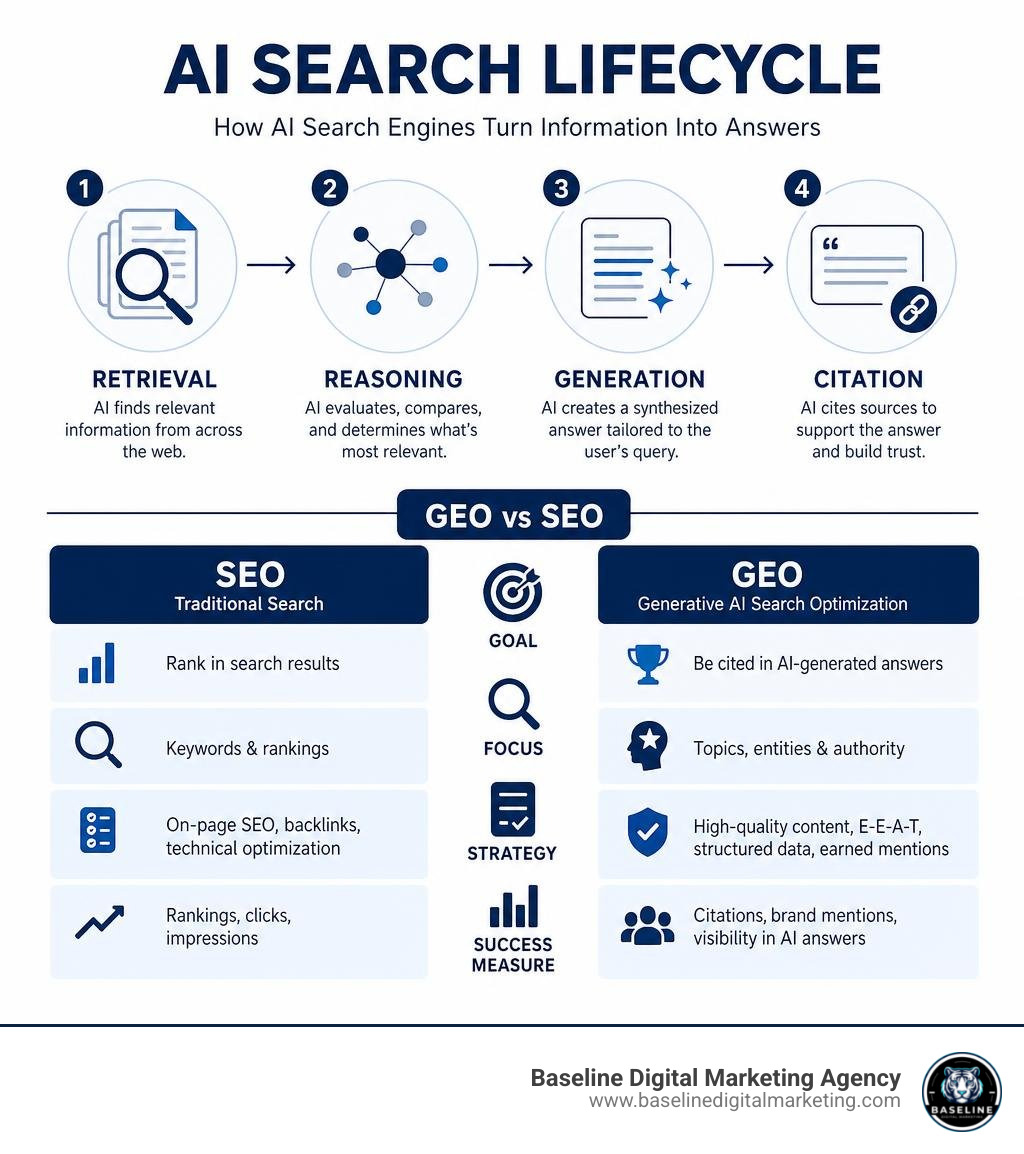
To understand Generative Engine Optimization (GEO), we first have to understand how modern AI search engines process information. Traditional search engines are index-and-retrieve systems. They crawl your site, index your keywords, evaluate your backlinks, and place you on a list of blue links.
AI search engines work differently. They rely on Retrieval-Augmented Generation (RAG). When a user asks a question, the AI doesn’t just look for pages containing those exact keywords. Instead, it retrieves relevant content from across the web, reasons through the information, synthesizes a custom response, and cites its sources.
Furthermore, Google uses a technique called query fan-out. When you type a complex query, Google’s systems generate multiple related queries in the background to fetch a wider, more comprehensive pool of search results before compiling its AI Overview.
Because of this, success in the AI era is measured by citation share—how often your brand is cited as a trusted source in these synthesized answers.
| Optimization Dimension | Traditional SEO | Generative Engine Optimization (GEO) |
|---|---|---|
| Primary Goal | Rank in the top 10 organic blue links | Earn citations and recommendations in AI answers |
| Search Mechanism | Keyword matching and backlink algorithms | Retrieval-Augmented Generation (RAG) and query fan-out |
| Content Focus | Targeting specific keywords and search volume | Providing comprehensive, unique, semantic answers |
| User Experience | Optimizing for page-level clicks | Satisfying conversational, multi-turn user intent |
| Key Metrics | Organic rankings, CTR, page views | Share of Model (SoM), citation frequency, sentiment |
If you want to dive deeper into how traditional search optimization forms the foundation for these new systems, check out our A Z Guide to SEO Services.
How AI Search Engines Evaluate and Cite Content
AI search engines do not treat all web pages equally. They have distinct biases built into their retrieval models. To optimize for generative ai search engine optimization, we must understand how different platforms like ChatGPT, Perplexity, and Gemini evaluate sources.
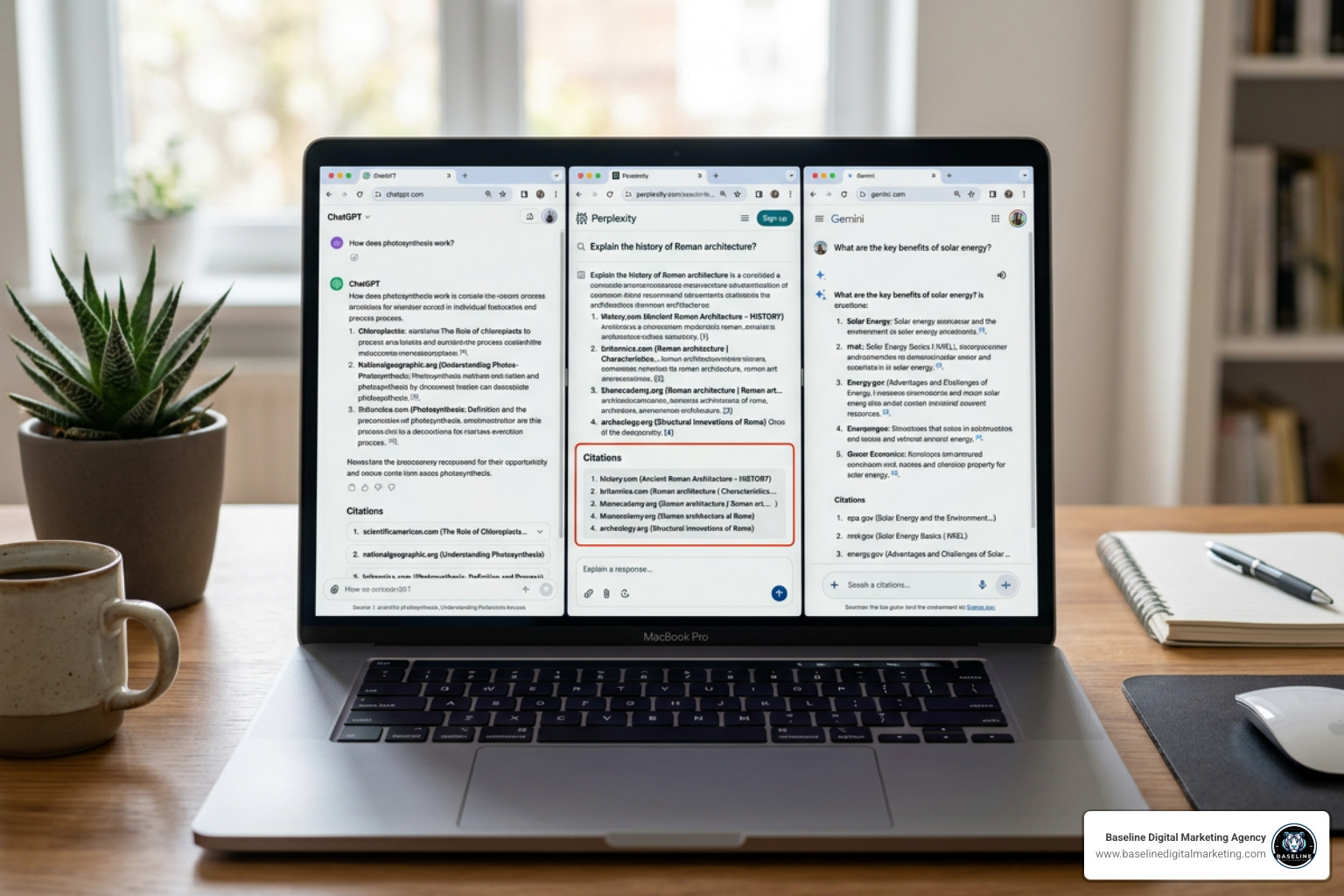
ChatGPT remains the dominant player in the conversational AI space, holding roughly an 81% global share of AI chatbots as of July 2025, with Similarweb recording 3.1 billion visits to chat.openai.com in late 2024. Its traffic is even projected to surpass traditional Google search traffic by October 2030. Meanwhile, Perplexity has established itself as a pure search competitor, processing 780 million monthly queries as of May 2025.
When these platforms search the live web to answer a user’s prompt, they display a systematic bias toward earned media (third-party reviews, news coverage, and industry publications) over brand-owned or social media content. In fact, studies show that up to 82% of AI citations come from earned media.
Furthermore, AI engines exhibit incredibly low domain overlap. Only about 11% of domains are cited by both ChatGPT and Perplexity for the same queries. This is because each platform uses its own proprietary weights for freshness, domain authority, and semantic relevance. To win citations, your brand must build a footprint that spans multiple authoritative, third-party sites. For a deeper technical dive into these retrieval models, you can explore the open-source community research available on krillinai/GEO .
Key Strategies for Generative AI Search Engine Optimization
Succeeding in this landscape requires moving away from “commodity content”—generic, AI-summarized articles that simply repeat what is already on the web. AI search engines have no reason to cite a page that offers nothing new.
Instead, we must focus on creating high-value, original content that provides unique perspectives, proprietary data, and first-hand expertise. For a broader look at how these dynamics are shifting the digital landscape, see How Generative AI Is Changing SEO – Skyword .
Our team at Baseline Digital Marketing recommends a four-pillar framework:
- Content Architecture: Structuring information so AI crawlers can easily parse and extract it.
- E-E-A-T and Trust: Verifying your brand’s authority through third-party validation.
- Technical AI Crawlability: Ensuring your site is fully accessible to LLM bots.
- Agentic Adaptability: Preparing your digital assets for autonomous AI agents.
Structuring Content for Generative AI Search Engine Optimization
To make your website easily readable for both humans and AI models, your content layout needs to be highly organized and structured.

Here is how to optimize your content structure for AI extraction:
- The Quick Answer Block: Place a concise, 100-to-150-word summary (a “TL;DR” block) at the very top of your pages. AI engines love to extract these blocks for quick summaries.
- Semantic Clarity: Use clear headings (H2s and H3s) and bulleted lists. AI models rely on clean semantic HTML to understand the hierarchy of your content.
- FAQ Schema: Implement structured data to explicitly map out questions and answers.
- Avoid Commodity Summaries: Do not write generic “7 Tips for Homebuyers” articles. Instead, write primary-source case studies like “How We Handled a Sewer Line Repair and Saved $5,000.”
Google’s official documentation heavily emphasizes that creating unique, people-first content remains the best way to earn visibility in AI Overviews. You can read their complete recommendations in Google’s Guide to Optimizing for Generative AI Features on Google Search | Google Search Central | Documentation | Google for Developers .
Additionally, ensuring a clean, crawlable site architecture is vital for AI discovery. Learn how to map your pages effectively in our guide to performing an Internal Linking Audit: How to Find Hidden Ranking Opportunities.
Building E-E-A-T and Authority for Generative AI Search Engine Optimization
Because AI engines synthesize answers from multiple sources, they need to verify that your brand is trustworthy before recommending you. This is where Google’s E-E-A-T (Experience, Expertise, Authoritativeness, Trustworthiness) framework becomes a direct input for AI decision-making.
To build this authority:
- Publish Original Research: Conduct annual industry surveys, publish proprietary benchmarks, or release whitepapers. When other sites reference your data, AI engines will attribute the original stat to you.
- Cultivate Earned Media: Secure positive mentions and reviews on independent platforms like Clutch, G2, or industry-specific journals.
- Maintain Author Bios: Every piece of informational content should be attributed to a real expert with verifiable credentials and links to their professional profiles.
An active, authoritative social footprint also signals credibility to search systems. Discover how to build a cohesive brand presence across channels with The Ultimate Guide to Social Media Marketing.
Technical Optimizations and Agentic GEO
As we look toward the future, we are entering the era of Agentic GEO. AI search is moving beyond simple search bars. We are now seeing the rise of autonomous AI agents that browse the web, evaluate options, and make purchasing decisions on behalf of users.
To prepare your site for agentic search and advanced AI crawlers, you must implement specific technical optimizations:
- Unblock AI Crawlers: Ensure your
robots.txtfile does not accidentally block user-agents likeGPTBot,PerplexityBot, orGoogle-Extended. - Structured Data Layer: Implement comprehensive JSON-LD schema markup for products, local businesses, and organization profiles. This makes your pricing, specifications, and reviews machine-readable.
- Visual Optimization: Optimize images, charts, and diagrams with descriptive alt text and captions. Modern Vision-Language Models (VLMs) can “see” and extract data from your images to include in multimodal search answers.
- Server-Side Rendering (SSR): Ensure your content renders server-side so Javascript-heavy pages do not slow down AI scrapers.
For a deeper look into how automated, self-evolving optimization systems are changing the web, read Agentic GEO: The Next Phase of AI Search Optimization Has Already Started | BabyPenguin.AI . If you run an online storefront, you can also audit your technical setup using The Ultimate Ecommerce SEO Audit Checklist to Boost Sales.
Measuring Success: Share of Model (SoM) and AI Visibility
In the age of generative search, traditional keyword rankings are no longer the primary indicator of success. Instead, we measure Share of Model (SoM).
Share of Model is the percentage of brand citations and recommendations your business receives across a set of target conversational prompts within a specific market.
To measure your SoM and AI visibility, we track several core metrics:
- Prompt Coverage: The percentage of relevant user prompts that trigger an answer containing your brand.
- Citation Frequency: How often your website is cited as a source in the generated output.
- Sentiment Index: Whether the AI’s synthesized response positions your brand in a positive, neutral, or negative light.
- Trust Density: The number of verifiable trust signals (such as links, schema, and reviews) parsed by the model per page.
By tracking these metrics quarterly, we can benchmark our AI visibility against competitors and continuously adapt our content to align with evolving model behaviors.
Frequently Asked Questions about Generative AI SEO
We hear many questions from business owners navigating this new search landscape. Here are the answers to the most common queries.
Is traditional SEO dead because of generative AI?
No, traditional SEO is not dead. Generative AI features on Google (like AI Overviews) are built directly on top of Google’s core ranking and indexation systems. If your site does not rank well or is not technically crawlable under traditional SEO standards, AI systems will not find or cite your content.
As detailed in Semrush’s analysis of Google’s latest releases, optimizing for generative search is a natural extension of foundational SEO best practices. You can read more about this in Google publishes guide to optimizing for generative AI search .
Do I need to create an LLMS.txt file for Google?
No. While some non-Google AI crawlers utilize llms.txt files to read website summaries, Google has officially stated that they do not treat llms.txt files specially. You do not need to create unique text files, markdown files, or special schema just to appear in Google’s generative AI features. For the official breakdown, refer directly to Optimizing your website for generative AI features on Google Search .
How long does it take to see results from GEO?
For real-time AI engines like Perplexity or Google AI Overviews, you can see new citations appear within 3 to 6 weeks of optimizing your content and structured data. For ChatGPT, visibility relies heavily on Bing’s indexing speed, which typically takes 2 to 4 weeks. You can watch a detailed video discussion on the safety, timeline, and execution of these tactics in Generative Engine Optimization: Is It Safe and How to Do … – YouTube .
Conclusion
The evolution of search is not a threat; it is an incredible opportunity. While zero-click searches and AI summaries are changing user behavior, the brands that adapt early will build a citation moat that competitors will find difficult to cross.
At Baseline Digital Marketing Agency, we specialize in helping businesses navigate this transition. From developing comprehensive SEO strategies to implementing cutting-edge website design and brand authority campaigns, we build the digital infrastructure your business needs to grow.
Ready to make your brand the default answer in generative search? Explore our specialized Service: AI Adoption program to see how we integrate intelligent systems into your workflows.
To future-proof your entire digital footprint across all platforms, partner with us to Optimize your brand with Search Everywhere Optimization. Let’s work together to make sure your business is citable, trusted, and visible wherever your customers are searching.