What Social Media Ads Actually Cost in 2026 (Quick Answer)
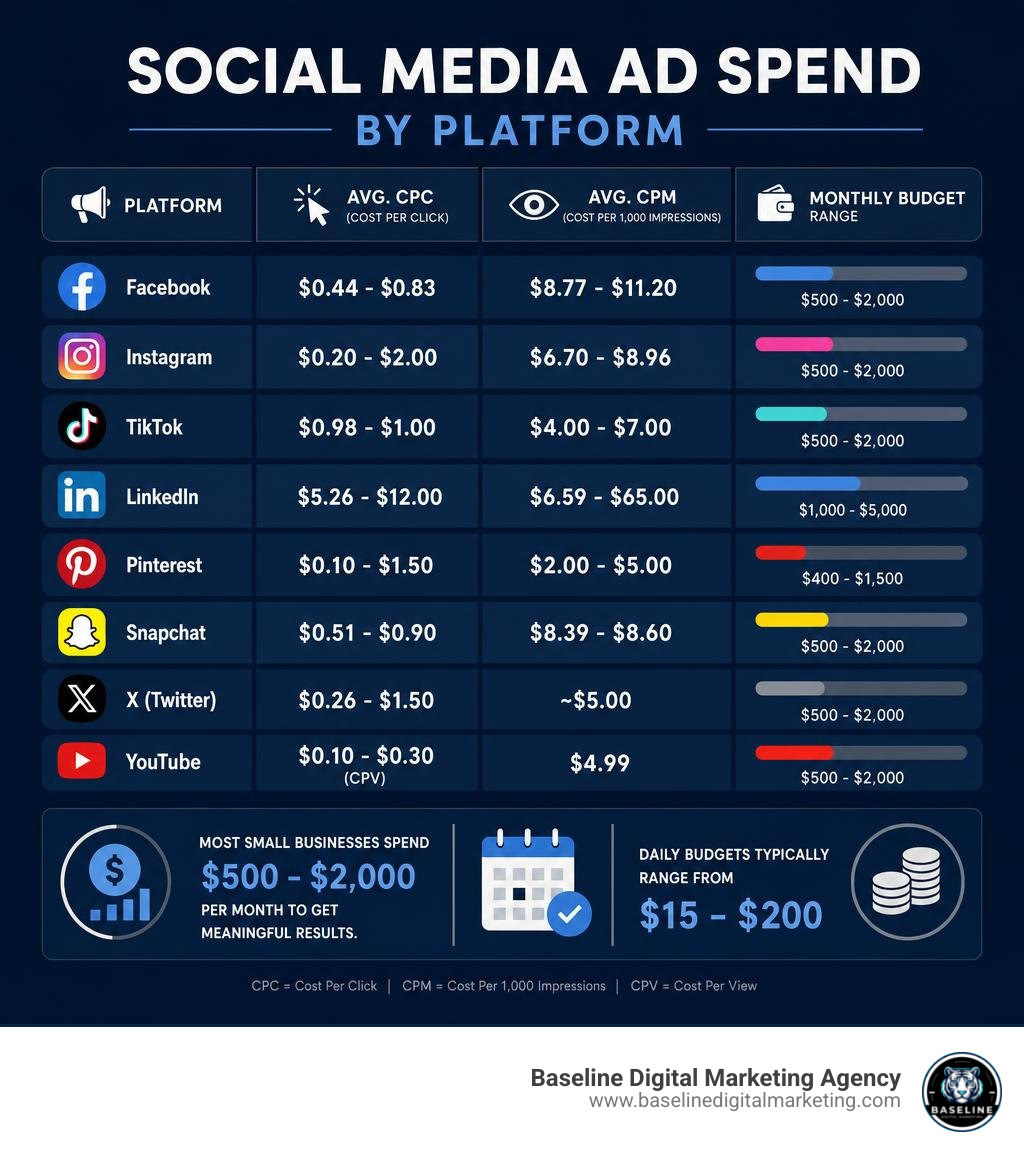
Social media ads cost anywhere from a few cents to several dollars per click depending on the platform, your audience, and your goals. Here’s a fast snapshot of what you can expect to pay across major platforms in 2026:
| Platform | Avg. CPC | Avg. CPM |
|---|---|---|
| $0.44 – $0.83 | $8.77 – $11.20 | |
| $0.20 – $2.00 | $6.70 – $8.96 | |
| TikTok | $0.98 – $1.00 | $4.00 – $7.00 |
| $5.26 – $12.00 | $6.59 – $65.00 | |
| $0.10 – $1.50 | $2.00 – $5.00 | |
| Snapchat | $0.51 – $0.90 | $8.39 – $8.60 |
| X (Twitter) | $0.26 – $1.50 | ~$5.00 |
| YouTube | $0.10 – $0.30 (CPV) | $4.99 |
Most small businesses spend between $500 and $2,000 per month to get meaningful results. Daily budgets typically range from $15 to $200.
If you’ve ever tried to get a straight answer on what social media ads actually cost, you already know how frustrating it can be. Every agency gives you a different number. Every platform has its own pricing logic. And the benchmarks you find online are often outdated by the time you read them.
Here’s the honest truth: there is no single fixed price. Social media advertising runs on auction-based systems, which means your costs shift based on who else is competing for the same audience, what platform you’re on, and how good your ad actually is.
What you can do is learn the benchmarks, understand what drives costs up or down, and build a budget that makes sense for your business — which is exactly what this guide is for.
I’m Carlos Alvarez, founder and CEO of Baseline Digital Marketing, and I’ve spent years helping small and mid-sized businesses navigate social media ads cost across platforms — figuring out where to spend, what to cut, and how to stretch every dollar further. Let’s break it all down so you can make smarter decisions starting today.
Learn more about social media ads cost:
What Determines Your Social Media Ads Cost?

When you enter paid social, you aren’t buying ad space like a traditional billboard. Instead, you are entering a highly dynamic, real-time auction. Every time a user scrolls down their feed, the platform’s algorithm runs a lightning-fast calculation to decide which ad to show them.
To master your budget, you must understand the primary levers that dictate your actual social media ads cost. As outlined in Social media advertising: Ads, cost & strategies | Adobe Express , several core factors shape your pricing:
- Target Audience Specificity: Who you want to reach matters immensely. Broad audiences (e.g., all adults in the US) typically enjoy lower costs per impression because there is plenty of ad inventory to go around. If you target highly specific niches—like C-suite executives at mid-sized software companies—you will pay a heavy premium.
- Ad Format and Creative Type: The visual structure of your ad directly impacts cost. Rich video formats, interactive carousel ads, and immersive story experiences often require higher initial production costs, but they can lower your distribution costs by driving significantly higher engagement.
- Auction Competition: Social media ad pricing is highly sensitive to supply and demand. If thousands of other brands are bidding on the exact same audience (such as e-commerce shoppers in November), your costs will naturally climb.
- Ad Quality and Relevance: Platforms care deeply about user experience. If your ad is boring, misleading, or has a low click-through rate, the platform will penalize you with higher costs. Conversely, highly engaging ads with excellent relevance scores receive better placements and lower bid requirements.
How Campaign Objectives Impact Your Social Media Ads Cost
One of the most common mistakes we see advertisers make is selecting the wrong campaign objective. When you set up a campaign, you must tell the platform what you want the user to do: build awareness, generate leads, or make a purchase.
Your choice here acts as a primary cost driver:
- Brand Awareness: If your goal is simply to get eyes on your brand, the algorithm will serve your ads to users who are highly likely to look at them, but not necessarily take action. This objective yields the lowest CPM (cost per thousand impressions), making it highly cost-effective for pure visibility.
- Lead Generation: When you ask for contact information—such as through an on-platform lead form—the algorithm targets users who have a history of filling out forms. This requires a moderate premium, but it strikes a fantastic balance for B2B and service-based companies.
- Conversions and Catalog Sales: If you want someone to pull out their credit card and buy a product, the platform will target high-intent shoppers. Because these users are incredibly valuable, conversion campaigns can cost up to six times more per click than simple engagement campaigns. However, they generate direct revenue events that justify the premium.
To align your overall marketing strategy with these objectives, explore The Ultimate Guide to Social Media Marketing for a deeper look at balancing top-of-funnel reach with bottom-of-funnel conversions.
Bidding Models: CPC vs. CPM
To control your spend, you must understand how you are being charged. The two primary bidding models used across social networks are CPC and CPM:
- Cost-Per-Click (CPC): You pay only when a user actively clicks on your ad. This model is ideal for driving targeted website traffic, capturing leads, or securing direct sales. If your ad gets a million impressions but zero clicks, you theoretically pay nothing (though the platform will eventually stop showing your ad if nobody clicks).
- Cost-Per-Thousand-Impressions (CPM): You pay a flat rate for every 1,000 times your ad is displayed on a screen, regardless of whether anyone clicks. This is the gold standard for brand awareness campaigns where maximum visibility is the primary goal.
- Cost-Per-View (CPV): Primarily used on video-heavy platforms like YouTube, you pay when a user watches a set portion of your video (typically 11 to 30 seconds) or interacts with it.
Most modern platforms calculate your actual CPC using a formula that bridges the two:
CPC = CPM ÷ (CTR × 10)
This relationship proves that CPC is not a static number; it is an output of your impression cost (CPM) and your click-through rate (CTR). If you can double your click-through rate through better creative quality, you can cut your cost-per-click in half without changing your budget or bidding strategy.
Platform-by-Platform Cost Benchmarks in 2026

Choosing where to invest your hard-earned marketing dollars requires a clear understanding of platform-specific costs. While a low cost-per-click sounds highly appealing, it is a misleading metric if those cheap clicks fail to convert.
As detailed in Average Price Per Click 2026: Benchmarks & Better Metrics , we must look at both CPC and CPM as diagnostic inputs rather than isolated goals. Let’s look at how the major networks compare in 2026.
Meta Ads: Facebook and Instagram
Meta remains the undisputed heavyweight of social media advertising, capturing roughly 60% of global social ad spend. However, advertising on Facebook and Instagram is not identical:
- Facebook: Boasting an average CPC of $0.44 to $0.83 and an average CPM of $8.77 to $11.20, Facebook offers some of the most stable and cost-effective traffic on the internet.
- Instagram: Because Instagram boasts significantly higher engagement rates, its ad space is more competitive. Expect an average CPC of $0.20 to $2.00, with average CPMs hovering between $6.70 and $8.96. Interestingly, Instagram Stories and Reels placements often deliver nearly half the CPC of the traditional Instagram Feed, making vertical video placements highly efficient.
Meta’s automated campaign tool, Advantage+, has completely reshaped how we budget. By leveraging machine learning to handle audience discovery, placements, and creative variations, Advantage+ campaigns can reduce your overall cost per result by up to 44%.
However, advertisers must also adapt to shifting regulatory and operational costs. For instance, as explained in Meta Ads Location Fees Introduced in Europe and Türkiye – LinkedIn , Meta has introduced localized regulatory transaction fees in specific regions like Europe and Türkiye. While these location-specific surcharges do not directly impact domestic-only US campaigns, they are a critical budget consideration for businesses running international campaigns.
TikTok and Snapchat: Rising or Falling?
If you are targeting Gen Z and younger Millennials, short-form vertical video platforms are essential. However, their cost dynamics are shifting rapidly:
- TikTok: With an average CPC of $0.98 to $1.00 and highly affordable CPMs ranging from $4.00 to $7.00, TikTok offers some of the cheapest awareness inventory on the market. However, TikTok requires a strict minimum daily campaign budget of $50 ($20 at the ad group level), which can be a barrier for very small businesses.
- Snapchat: Snapchat has experienced massive year-over-year growth, with CPM rates climbing as much as 47% in recent periods. Despite this inflation, its average CPC remains affordable at $0.51 to $0.90, and CPMs average $8.39 to $8.60. Snapchat’s low minimum ad buy of just $5 makes it highly accessible for testing.
While both platforms offer incredibly cheap reach, they demand highly native, creator-style content. Polished, corporate-looking ads perform terribly here; instead, successful campaigns rely on low-fidelity, authentic User Generated Content (UGC) that feels like a natural post rather than an interruption.
B2B and Niche Networks: LinkedIn, Pinterest, and X (Twitter)
For businesses looking beyond mass-consumer audiences, niche platforms offer highly specialized targeting capabilities:
- LinkedIn: LinkedIn is undeniably the most expensive advertising platform, with average CPCs starting at $5.26 and frequently exceeding $12.00. CPMs range from $33.00 to over $65.00. However, for B2B brands with large deal sizes (where a single client is worth $10,000+), paying a premium for precise professional targeting is incredibly lucrative.
- Pinterest: Pinterest is a visual search engine where 85% of weekly users have purchased something based on pins they’ve seen. With CPCs ranging from $0.10 to $1.50 and CPMs between $2.00 and $5.00, it represents an incredibly cost-effective option for lifestyle, fashion, home decor, and e-commerce brands.
- X (Twitter): X operates on a lower-cost model, with CPCs averaging $0.26 to $1.50 per action. While CPMs hover around $5.00, the platform’s recent volatility means advertisers should monitor brand safety and placement quality closely.
For a detailed breakdown of how visual elements and niche audience targeting affect your bottom line, review the insights in Social Media Ads Cost Breakdown by Platform – AdRoll .
Seasonal Trends and Budgeting Frameworks
Just like physical retail space, digital ad space gets incredibly crowded during certain times of the year. If you run your campaigns with a flat, unchanging budget year-round, you will likely overpay during competitive seasons and miss major opportunities during quiet periods.
Seasonal Fluctuations and Year-Over-Year Shifts
The final quarter of the year (Q4) is a notoriously expensive time to advertise. As brands gear up for Black Friday, Cyber Monday, and the holiday shopping rush, competition for consumer attention drives seasonal CPM increases of up to 66% on platforms like Meta. The week of Thanksgiving and Black Friday represents the absolute peak of ad pricing.
Furthermore, major external events—such as presidential election cycles—can inject billions of dollars of political ad spend into the digital ecosystem. This sudden influx of capital drives up ad-rate inflation across television, Connected TV (CTV), and major social networks, pushing CPMs up by as much as 40% in the weeks leading up to Election Day.
Interestingly, smart marketers have begun leveraging a hidden mini-season known as “Q5.” This is the period starting immediately after Christmas and running through mid-January. During Q5, major retailers pull back their massive holiday budgets, causing CPMs to plummet by 15% to 25%. However, consumer purchasing intent remains incredibly high as people look to spend holiday gift cards, return unwanted items, or focus on New Year’s resolutions.
To navigate these complex seasonal cycles, check out Social Media Advertising: The Complete Guide for 2026 | rule1 for advanced data-driven campaign mapping.
Actionable Strategies to Lower Your Social Media Ads Cost
You do not have to accept high ad costs as an inevitability. By implementing a few structural optimizations, you can significantly lower your costs while improving your campaign return on investment (ROI):
- Improve Your Hook Rate: The first three seconds of a video ad are the most critical. By testing radically different visual hooks, you can boost your click-through rate (CTR), which signals high quality to the platform’s algorithm and directly lowers your effective CPC.
- Broaden Your Audiences: Instead of hyper-targeting tiny, expensive interest groups, use broader targeting and let your ad creative do the filtering. Modern AI-driven algorithms are exceptionally good at finding the right buyers within a large audience pool, and broader audiences enjoy much lower CPMs.
- Implement Proper Exclusions: Stop wasting ad spend on people who have already bought your product. Set up custom audience exclusions to remove past purchasers and active leads from your prospecting campaigns.
- A/B Test Systematically: Never assume you know which ad will perform best. Run structured tests comparing different headlines, images, and call-to-action buttons. Only scale the winners and pause the underperforming variations early.
If you want to ensure your business is partnering with the right team to execute these optimizations, read our guide on how to Swipe Right on the Perfect Social Media Agency for Your Business.
Small Business Budgeting Frameworks
If you are a small business owner, you might be wondering: How do I structure my actual budget without burning through cash? We recommend using the 70/30 Rule:
- 70% of Your Budget (The Engine): Allocate this to proven, high-performing campaigns, targeting audiences and utilizing creatives that have consistently generated leads or sales.
- 30% of Your Budget (The Lab): Protect this portion strictly for testing. Use it to try out new platforms, experiment with fresh ad formats, or test creative concepts.
To calculate your absolute minimum weekly budget for a conversion campaign, use the Learning Phase Formula:
Minimum Weekly Budget = 50 Conversions × Your Target Cost-Per-Acquisition (CPA)
For example, if your target CPA is $20, you need to secure roughly 50 conversions per week for Meta’s algorithm to stabilize and exit the “learning phase.” This means your starting budget should be at least $1,000 per week ($142 per day) on that specific campaign to give the algorithm enough data to optimize efficiently. If your budget is tighter, focus on a higher-funnel objective (like lead generation or link clicks) where securing 50 conversion events per week is more affordable.
Frequently Asked Questions About Social Media Ad Costs
What is a good starting monthly budget for social media ads?
For most small to medium-sized businesses, a starting budget of $500 to $2,000 per month is ideal. This range provides enough daily budget ($15 to $65 per day) to run basic campaigns, test a few creative variations, and gather enough data to see what works without overextending your finances.
Which social media platform is the most expensive to advertise on?
LinkedIn is by far the most expensive platform, with average CPCs often exceeding $5.00 to $12.00 and CPMs running up to $65.00. However, because it allows you to target users by exact job title, company size, and industry, it remains highly profitable for high-value B2B sales and professional services.
How often should I refresh my ad creatives to avoid cost spikes?
At a spend level of $1,000 per week or more, you should plan to refresh your visual hooks and ad creatives every 7 to 10 days. Keep a close eye on your campaign “frequency” metric. When the average user has seen your ad more than 3 to 4 times on Meta (or 5 to 6 times on TikTok), “creative fatigue” sets in, causing your click-through rates to drop and your costs to spike.
Conclusion
Navigating social media advertising does not have to be a guessing game. While social media ads cost will always fluctuate based on competition, seasonality, and your target audience, you have massive leverage over what you ultimately pay. By focusing on creative quality, selecting the correct campaign objectives, and structuring your budget with room for testing, you can build campaigns that deliver consistent, profitable growth.
At Baseline Digital Marketing Agency, we specialize in helping businesses cut through the noise. We develop tailored digital strategies, implement advanced SEO, deliver cutting-edge AI automation, build high-converting websites, and craft powerful branding to help your business thrive online.
Ready to stop guessing and start scaling? Partner with Baseline Digital Marketing Agency for Expert Social Media Marketing and let our team build a high-performing, cost-optimized ad strategy designed specifically for your business goals.