
Introduction
Why Most SaaS Companies Are One Good Story Away From Standing Out
Brand storytelling for SaaS companies is the practice of building consistent, emotion-driven narratives that connect your software to the real human problems it solves — instead of leading with features, specs, or pricing.
Here’s a quick breakdown of what it involves and why it works:
| Element | What It Means for SaaS |
|---|---|
| The Hero | Your customer, not your product |
| The Conflict | The painful problem they face every day |
| The Guide | Your brand, offering a clear path forward |
| The Resolution | The transformation your software enables |
| The Result | Trust, loyalty, and measurable growth |
Think about this for a second.
You’ve built a great product. Your feature set is solid. Your pricing is competitive. But so is everyone else’s.
In a market where buyers often have 10+ tabs open comparing nearly identical tools, features alone don’t close deals. What does? Emotional connection.
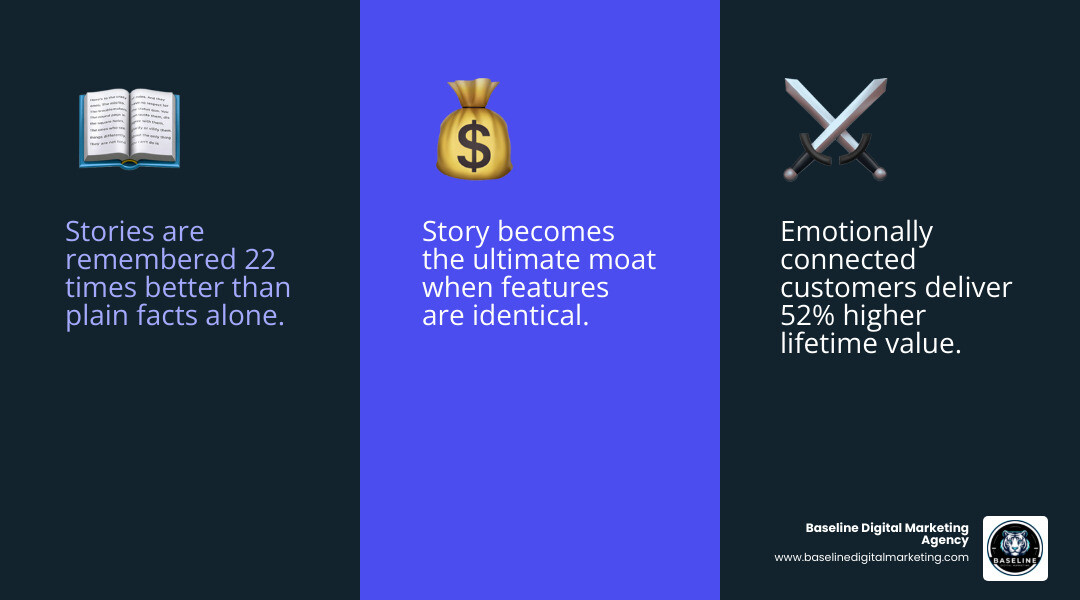
The numbers back this up. People remember stories 22 times more than they remember facts. And customers who feel emotionally connected to a brand are 52% more valuable than those who are simply satisfied. Yet most SaaS marketing still leads with dashboards, integrations, and bullet-point feature lists.
That’s the gap — and it’s a big one.
The SaaS market has never been more crowded. AI is accelerating product development so fast that any technical advantage can be replicated in months. What can’t is your story: why you exist, who you serve, and what you genuinely believe about the problem you’re solving.
That’s why brand storytelling isn’t a “nice to have” anymore. For SaaS companies competing in saturated categories, it’s the last real moat.
I’m Carlos Alvarez, founder and CEO of Baseline Digital Marketing, with years of experience helping B2B and SaaS companies cut through the noise using strategy-driven brand narratives. My work at the intersection of business leadership, digital marketing, and AI adoption gives me a front-row seat to how brand storytelling for SaaS companies directly shapes growth, customer retention, and competitive positioning. In this guide, I’ll walk you through exactly how to build and use that narrative — step by step.
Why Brand Storytelling for SaaS Companies is the Ultimate Competitive Moat
In May 2026, the SaaS landscape is more crowded than ever. We’ve seen a massive surge in AI-driven tools, which means technical features that used to take years to build can now be replicated in weeks. This “feature parity” has created a commoditization trap. If you lead with features, you are essentially telling your prospects that you are a utility. And utilities are chosen based on the lowest price.
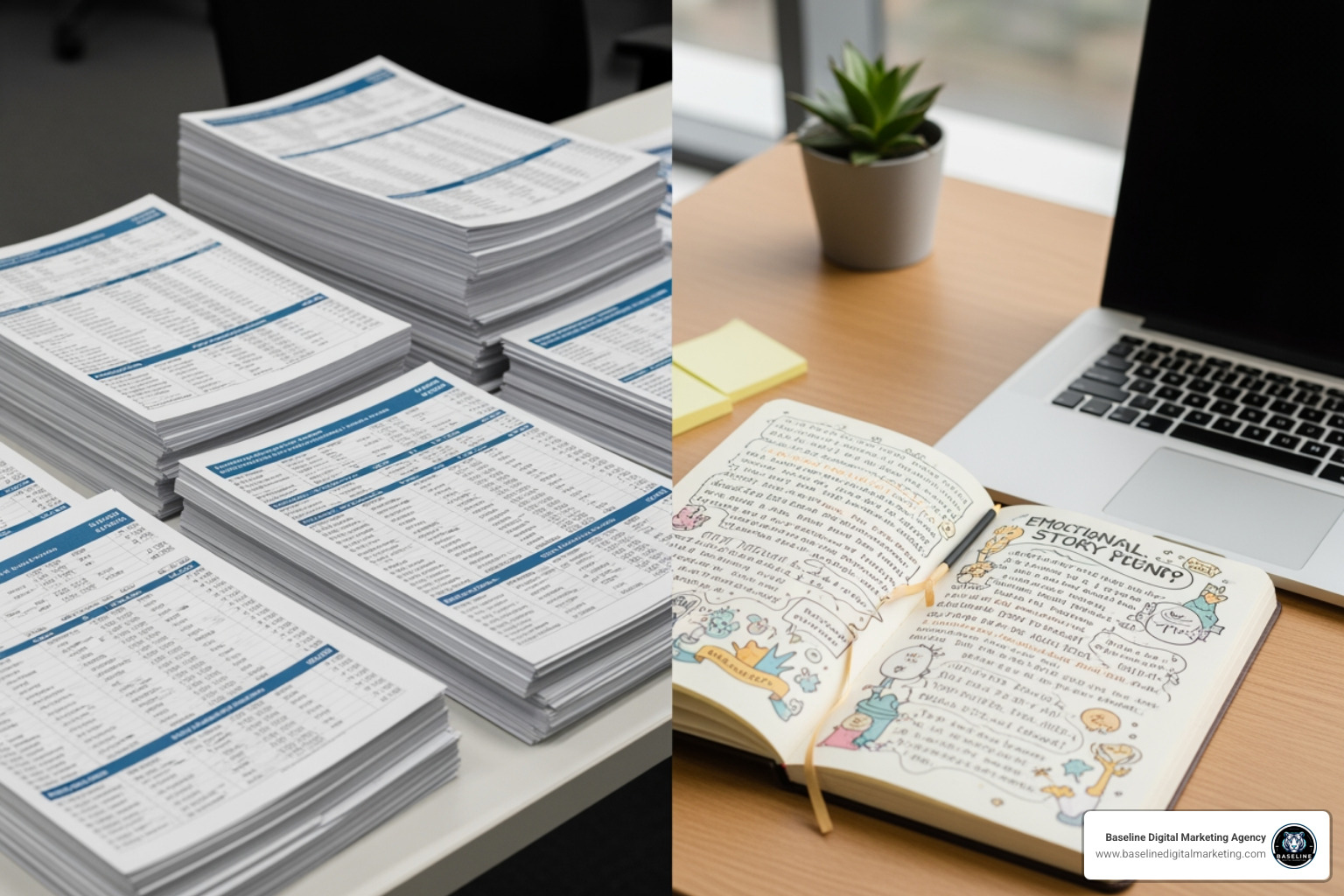
To escape this, we need to build a “Story Moat.” While a competitor can copy your dashboard layout or your API integrations, they cannot copy your unique perspective, your founding mission, or the emotional resonance you have with your users. As noted in Brand Storytelling: The Complete Guide for 2026, storytelling is the only real moat left because it optimizes for recall and sentiment rather than just clicks.
At Baseline Digital Marketing, we believe The Art of Crafting Compelling Brand Stories lies in moving up the “benefit ladder.” You start at the bottom with functional features (what it does), move to emotional benefits (how it helps), and finally reach visionary beliefs (why it matters).
Feature-Led vs. Story-Led Growth
| Feature-Led Marketing | Story-Led Growth |
|---|---|
| Focuses on “What” and “How” | Focuses on “Why” and “Who” |
| Triggers logical comparison (12 tabs open) | Triggers emotional resonance and trust |
| Short-term focus on transactions | Long-term focus on relationships and loyalty |
| Easily replicated by competitors | Defensible, unique competitive advantage |
| Higher CAC due to noise saturation | Lower CAC through organic mental availability |
By focusing on brand storytelling for SaaS companies, we build “mental availability.” This means when a buyer finally decides they need a solution, your brand is the first one they think of because your story stuck with them long before they were “in-market.” Only about 5% of your buyers are looking to buy right now; the other 95% need a story to remember you by when their time comes.
Proven Frameworks to Create SaaS Brand Narratives
We don’t need to reinvent the wheel to tell a great story. Humans have been using the same narrative structures for thousands of years. For SaaS, the goal is to take complex, abstract software and ground it in a recognizable human journey.
One of the most effective ways to Master Brand Storytelling on Your SaaS Website is to use established frameworks like the Hero’s Journey or the Pixar Framework. These structures ensure your narrative has tension, a turning point, and a resolution.
In a typical 3-Act structure for SaaS:
- Act 1 (The Setup): Introduce the protagonist (your customer) in their current world, struggling with a specific “Villain”—usually chaos, inefficiency, or legacy manual processes.
- Act 2 (The Conflict): The problem worsens. The old ways of working are failing.
- Act 3 (The Resolution): Your brand appears as the Mentor, providing the “Magical Tool” (your SaaS) that allows the Hero to defeat the Villain and achieve a new, better state of being.
We dive deeper into these structures in A Guide for Businesses in the Digital Age, emphasizing that the brand must always be the guide, never the hero.
Implementing the StoryBrand Framework for SaaS
The StoryBrand framework is particularly powerful for brand storytelling for SaaS companies because it forces clarity. If you confuse, you lose.
- The Hero: Your customer (e.g., Jane, the overwhelmed IT Manager).
- The Problem: Internal (frustration), External (system downtime), and Philosophical (it shouldn’t be this hard).
- The Guide: Your SaaS brand, expressing Empathy (“We’ve been there”) and Authority (“We’ve helped 500 companies fix this”).
- The Plan: A simple 3-step path to success (Sign up, Integrate, Relax).
- The Call to Action: A clear “Buy Now” or “Start Free Trial.”
- Success vs. Failure: Clearly paint the picture of what life looks like with your tool versus the continued chaos without it.
Using Brand Storytelling for SaaS Companies to Simplify Complex Tech
SaaS products are often abstract. You can’t touch them; you can only see the results. This is where metaphors and sensory details become vital.
When we look at How to Maximize Startup Value with Digital Product Design Strategies for Growth, we see that design and narrative work together to reduce “time-to-understanding.” If a prospect has to spend ten minutes figuring out what your “AI-driven hyper-scale orchestration layer” actually does, they will leave.
Instead, use an analogy: “It’s like having an air traffic controller for your data.” This immediately reduces the cognitive load and makes the value proposition concrete.
Mapping Your Narrative Across the SaaS Buyer’s Journey
A story isn’t just for your “About Us” page. It needs to be woven through every touchpoint of the funnel.

According to the research in From Story to Sale: Mapping Narrative Across the SaaS Funnel, narratives should evolve as the buyer moves closer to a decision:
- TOFU (Top of Funnel): Focus on Category Narratives. Talk about the “Old Way” vs. the “New Way.” Challenge the status quo. You aren’t selling a product yet; you’re selling a vision of a better future.
- MOFU (Middle of Funnel): Focus on Persona Narratives. This is where you get specific about the Hero’s pain. Use “Day in the Life” stories that make the prospect say, “They actually understand my job.”
- BOFU (Bottom of Funnel): Focus on Product Narratives and Proof. This is where the story becomes grounded in reality through transformation evidence.
Optimizing BOFU Assets with Brand Storytelling for SaaS Companies
In the final stages, your story needs to prove that the “transformation” is real. Case studies are the perfect vehicle for this, but they shouldn’t be dry lists of results. They should be “Mini-Hero’s Journeys.”
For example, our look at how Design That Drives Growth: A Wellness App Elevates Retention Rates by 42% isn’t just about the 42% stat—it’s about the journey of the users who felt more connected to their health goals because of the intuitive narrative flow of the app.
When writing BOFU assets:
- Don’t just list features: Explain how the feature was the “turning point” for the customer.
- Use real quotes: Let your customers tell the “climax” of the story.
- Quantify the resolution: Use specific numbers to show the Hero won the battle (e.g., “Saved 10 hours a week,” “Reduced churn by 15%”).
Measuring the Impact of Narrative on Business Growth
One of the biggest myths in marketing is that storytelling is “fluff” that can’t be measured. In reality, brand storytelling for SaaS companies is a strategic infrastructure that drives hard business metrics.
As we explore in How Analytics Can Drive Business Success, you can measure the impact of your narrative through several key performance indicators (KPIs):
- Direct Conversion Rates: Use incrementality testing. Show a story-driven landing page to half your traffic and a feature-driven one to the other. Narrative-led pages typically see higher conversion because they build trust faster.
- Sales Cycle Length: Strong storytelling builds “pre-trust.” If a prospect arrives at a sales call already believing in your vision, the cycle is shorter.
- Customer Lifetime Value (CLV) and Retention: Emotionally engaged clients are 52% more valuable. They stay longer and are less likely to churn over a minor price increase because they aren’t just buying a tool; they are part of your “storyworld.”
- Brand Sentiment and Share of Voice: Are people talking about your brand as a leader or just another vendor?
However, be careful of the “Uncomfortable Truth.” As discussed in The Uncomfortable Truth About Brand Storytelling, if your story doesn’t match the actual product experience, you will create a “perception gap” that leads to high churn. Your story must be authentic and backed by the product’s reality.
Frequently Asked Questions about SaaS Storytelling
How do you differentiate a SaaS brand when features are identical?
When features are identical, the differentiator is the “Worldview.” Buyers don’t just choose the tool; they choose the world they want to live in. Do they want the “snarky, insider” vibe of a tool like Slack, or the “clean, minimalist, organized” world of Notion? Your brand’s personality, language, and rituals create a storyworld that competitors cannot replicate.
What are the most common storytelling pitfalls to avoid?
The most common pitfall is making the brand the Hero. Your brand is the Mentor (Yoda), not the Hero (Luke). Other pitfalls include:
- Feature Dumping: Masking a list of specs as a “story.”
- Abstract Messaging: Using jargon like “leveraging synergistic paradigms” instead of human language.
- Inconsistency: Telling one story on social media and a completely different one inside the product.
How can early-stage startups build a story with no history?
Startups have the most exciting stories: the Founding Tension. Why was the founder so obsessed with this problem that they quit their job to build a solution? Talk about the “Big Change” in the world that made your product necessary now. Your story isn’t about your past; it’s about the future you are building for your customers.
Conclusion
At Baseline Digital Marketing Agency, we don’t just see storytelling as a creative exercise. We see it as strategic infrastructure. In an era where AI can generate code and content in seconds, your unique brand narrative is the only scalable way to differentiate and win.
Whether you are an early-stage startup looking for your “founding spark” or a mature SaaS company needing to escape the feature trap, building a consistent storyworld is the key to lower CAC and higher loyalty. We specialize in helping tech companies find that narrative and weave it into their Brand Strategy to drive measurable growth.
Ready to stop listing features and start telling a story that sells? Build your narrative at our Branding Studio and let’s turn your software into a story your customers want to be a part of.