Search Is No Longer Just Google — Here’s What That Means for Your Business
Search everywhere optimization is the practice of making your brand easy to find across all the platforms where people search — not just Google.
Here’s a quick breakdown:
| What It Is | What It Covers |
|---|---|
| A multi-platform visibility strategy | Google, TikTok, YouTube, Amazon, Instagram, Pinterest, App Stores, AI tools (ChatGPT, Perplexity, Gemini), voice search, and more |
| An evolution of traditional SEO | Expands beyond website rankings to include social search, marketplace search, and AI-generated answers |
| Also called SEOx or SEO 2.0 | Focused on being found, trusted, and chosen — everywhere your customers look |
Think about the last time you researched a product before buying it. You probably didn’t just Google it once and call it done.
Maybe you watched a TikTok review. Checked YouTube for a demo. Scrolled Amazon for ratings. Asked ChatGPT for a comparison. Then you decided.
That messy, multi-stop journey is how most people search today — especially younger consumers. In fact, 40% of young people now turn to TikTok or Instagram before Google when looking for products or recommendations. And Google? It only accounts for 18% of the 45 billion searches that happen every day across all platforms.
If your business is only showing up on Google, you’re invisible for the majority of that journey.
That’s the problem search everywhere optimization solves.
I’m Carlos Alvarez, founder and CEO of Baseline Digital Marketing Agency, and I’ve spent years helping businesses build multi-platform digital strategies — including search everywhere optimization frameworks that drive real, measurable growth. In this guide, I’ll walk you through exactly what SEOx is, why it matters right now, and how to build a strategy that works for your business.
What is Search Everywhere Optimization (SEOx)?
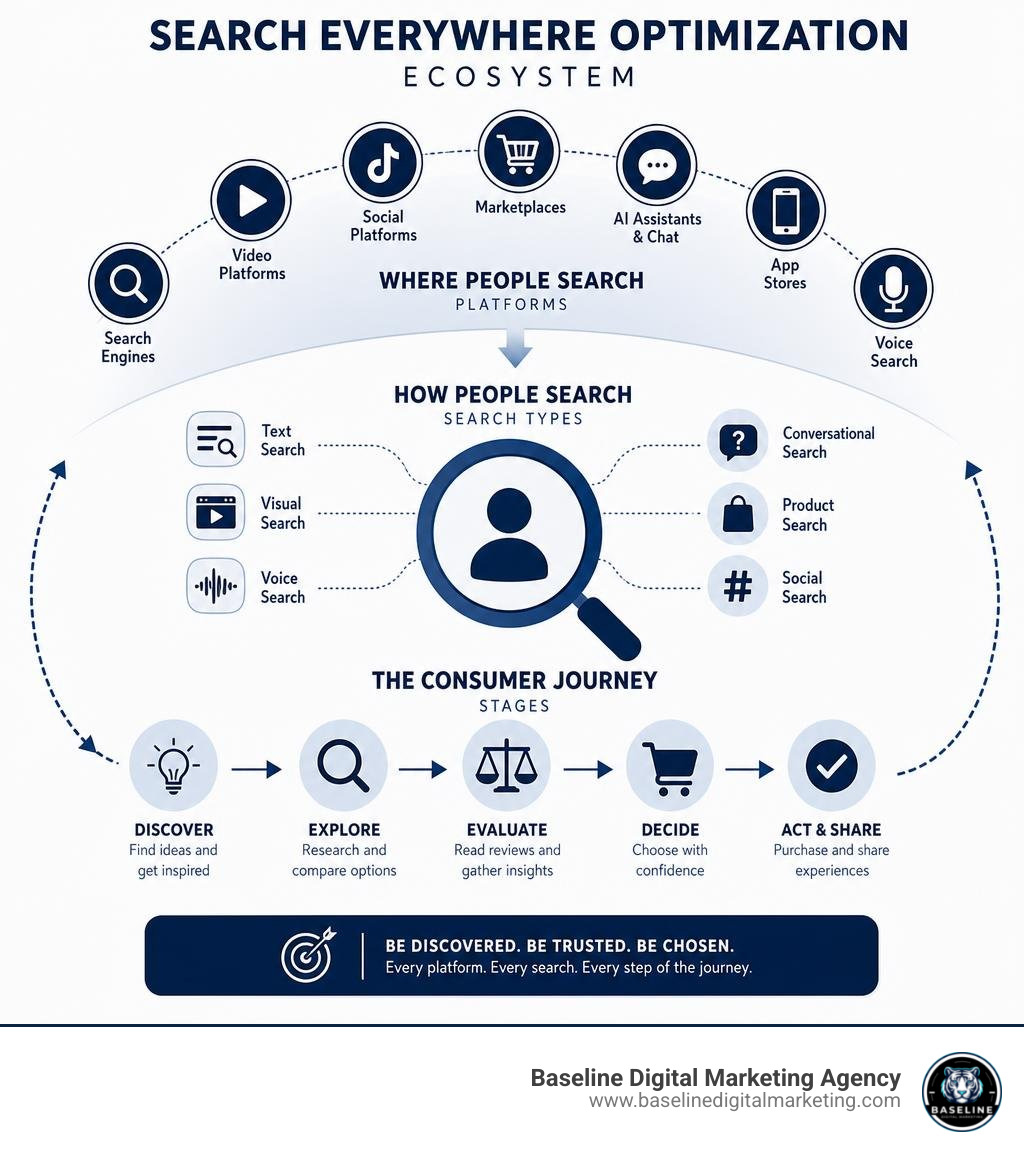
Search Everywhere Optimization, or SEOx, is the practice of improving your visibility across every platform where your audience searches, compares, asks, scrolls, shops, and makes decisions.
Traditional SEO asks, “How do we rank this page in Google?”
SEOx asks a bigger question: “How do we make our brand findable, understandable, trusted, and chosen across the full search journey?”
That includes:
- Google and other web search engines
- TikTok, Instagram, YouTube, Pinterest, LinkedIn, and other social search platforms
- Amazon, Walmart, Etsy, and other ecommerce search engines
- App Stores
- AI tools like ChatGPT, Perplexity, Gemini, and AI Overviews
- Reddit, Quora, forums, and community spaces
- Maps, local listings, voice assistants, and review platforms
A helpful way to think about SEOx is “brand footprint optimization.” Your website is still important, but it is only one part of the footprint. AI tools, social algorithms, marketplace rankings, video search, creator mentions, reviews, and community conversations all help shape whether people see you as the right answer.
For a formal definition of the concept, this guide from Michigan Technological University explains what Search Everywhere Optimization means across traditional search, app stores, ecommerce, social, AI, local, voice, and niche platforms.
At Baseline Digital Marketing Agency, we think of SEOx as the natural expansion of SEO. It keeps the good parts of classic search strategy, like keyword research, technical health, content quality, and authority, but applies them to the real way people search in 2026.
The Evolution of Search Everywhere Optimization in 2026
Search behavior has changed because the internet changed.
For years, users typed a query into Google, clicked a blue link, and visited a website. That still happens, and it still matters. Google processes more than 8.3 billion searches a day, and organic search still drives about 53% of website traffic.
But now, users also ask AI tools for summarized answers. They search TikTok for real-life product examples. They watch YouTube for tutorials. They browse Amazon for reviews. They check Reddit for unfiltered opinions. They may never click a website at all.
This is especially important because zero-click experiences are growing. Google AI Overviews, featured snippets, knowledge panels, social search results, and AI-generated answers can satisfy a search without sending the user to your site.
That does not mean SEO is dead. It means the target is wider.
A modern SEO program now needs to support:
- Website rankings
- Brand mentions
- AI citations
- Video visibility
- Social discovery
- Marketplace rankings
- Review signals
- Community trust
- Entity clarity
Entity clarity simply means that search systems and AI tools understand who you are, what you offer, who you serve, and why you are credible. If your brand information is inconsistent across your website, social profiles, listings, videos, product pages, and third-party mentions, you make the machines work too hard. And machines, like tired humans before coffee, do not always make the best decisions.
If you want the foundation before expanding into SEOx, our A-Z Guide to SEO Services is a strong starting point.
Why Traditional SEO is No Longer Enough in 2026
Traditional SEO is still essential. But relying on traditional SEO alone is risky.
Here is why:
- Search no longer happens in one place.
- Google updates can change traffic overnight.
- AI answers reduce click-through opportunities.
- Younger users increasingly prefer social platforms for discovery.
- Ecommerce buyers often start directly on marketplaces.
- Brand trust is built across many touchpoints, not one ranking.
The statistics tell the story:
- Google accounts for only 18% of the 45 billion searches happening daily across all platforms.
- 40% of young consumers turn to TikTok or Instagram before Google.
- 33% of people start their online shopping journey on Instagram or TikTok.
- 56% of U.S. shoppers start product searches on Amazon.
- More than 13 million U.S. adults now use ChatGPT as their primary search tool.
That is a lot of searching happening outside the traditional search engine results page.
And mobile behavior makes this even more important. People searching on mobile often use shorter, more immediate, platform-native searches. They might type “best serum dry skin” into TikTok, “wireless earbuds running” into Amazon, or “how to fix slow website” into YouTube. If your strategy only covers Google desktop queries, you are missing a massive chunk of demand. Our guide, Don’t Let Your Mobile Rankings Go South, explains why mobile search performance still needs close attention.
| Traditional SEO | Search Everywhere Optimization |
|---|---|
| Focuses mainly on Google rankings | Focuses on visibility across search, social, AI, ecommerce, video, and communities |
| Measures rankings, clicks, traffic, and backlinks | Measures visibility, engagement, branded search, mentions, citations, reviews, conversions, and revenue |
| Optimizes webpages | Optimizes webpages, videos, profiles, listings, product pages, app pages, posts, and answers |
| Targets search engines | Targets search engines, platform algorithms, AI systems, and human trust signals |
| Often website-led | Full-funnel and cross-channel |
| Success is “rank higher” | Success is “get found, trusted, and chosen” |
A useful external overview of this shift is this Search Everywhere Optimization playbook, which frames the challenge as showing up wherever discovery happens.
Platform-by-Platform Playbook for SEOx
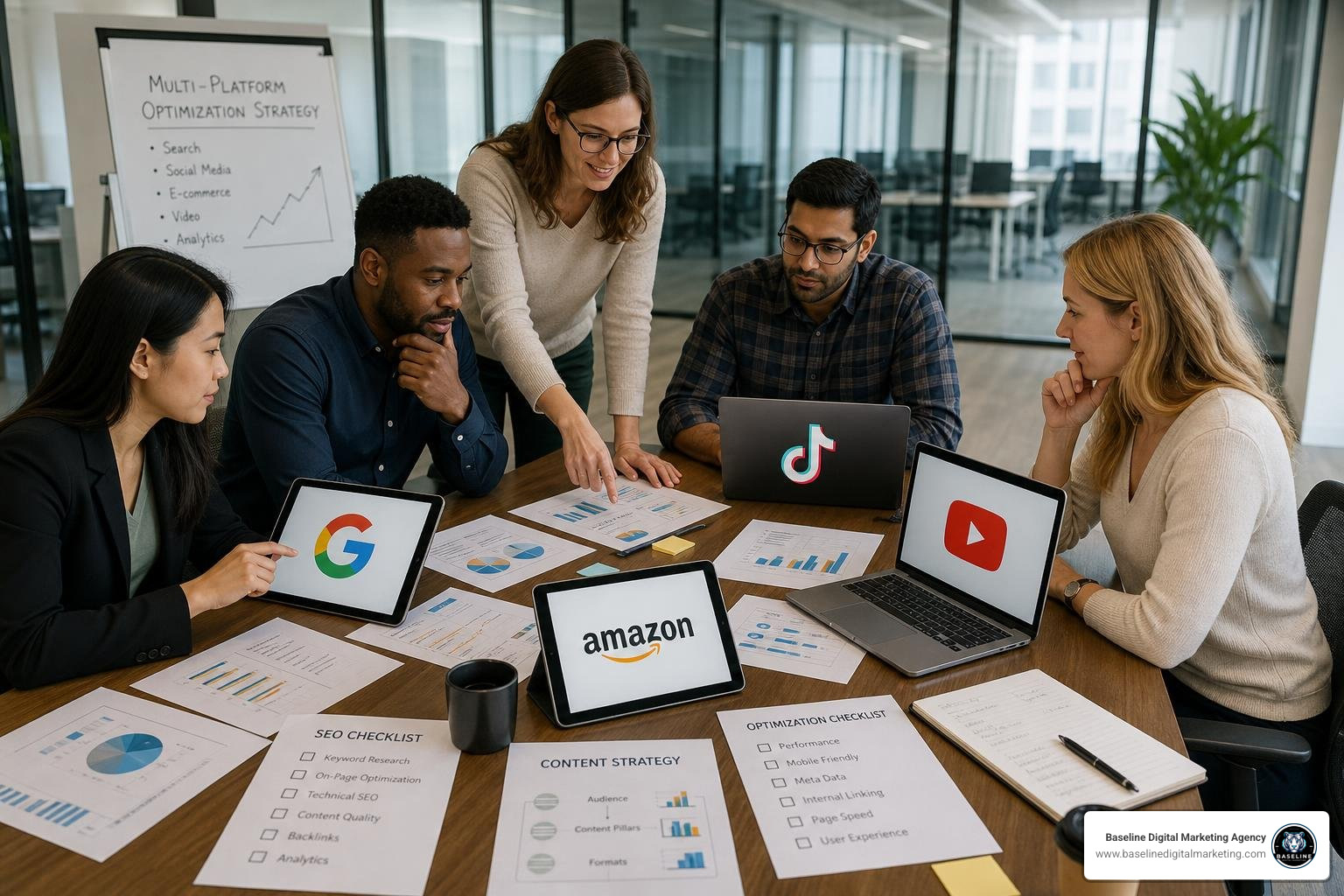
You do not need to optimize for every platform at once. Please do not try. That is how teams burn out, budgets evaporate, and someone ends up making a brand TikTok dance that should have stayed in the drafts.
Start with your audience. Where do they search before buying? Where do they compare options? Where do they look for proof? Where do they ask questions?
For many businesses, the most important SEOx platforms fall into these groups:
- Social and video: TikTok, Instagram, YouTube, Pinterest
- Ecommerce: Amazon and other marketplaces
- AI search: ChatGPT, Perplexity, Gemini, AI Overviews
- App discovery: Apple App Store and Google Play
- Community discovery: Reddit, Quora, niche forums
- Traditional search: Google and Bing
- Local and voice: maps, review platforms, voice assistants
The most important planning principle is simple: platform selection should start with audience behavior, not hype. The best platform is the one your customers actually use.
Optimizing for Social Search and Video Platforms
Social platforms are now search engines with entertainment attached.
Users search TikTok for best budget skincare, Instagram for outfit ideas, YouTube for product demos, and Pinterest for visual inspiration. These platforms each have their own ranking signals, but the general principles are similar.
For TikTok and Instagram:
- Use keywords in captions, on-screen text, and spoken audio.
- Hook viewers in the first 2 to 3 seconds.
- Use niche-specific hashtags instead of only broad tags.
- Create native content, not repurposed ads pretending to be native content.
- Post consistently enough to learn what your audience responds to.
- Encourage saves, shares, comments, and completion rates.
- Use trends carefully. Trend-chasing without relevance is just cardio for your content team.
For YouTube:
- Put the main keyword near the beginning of the title.
- Write clear descriptions with related phrases and links.
- Add chapters and timestamps.
- Use custom thumbnails that communicate the video promise quickly.
- Add captions and transcripts.
- Group related videos into playlists.
- Optimize for watch time, retention, and session continuation.
YouTube is especially powerful because it behaves like a traditional search engine and a recommendation engine. People often use it for high-intent research: tutorials, comparisons, reviews, troubleshooting, and demonstrations.
For Pinterest:
- Use high-quality vertical images.
- Add keyword-rich pin titles and descriptions.
- Organize boards around search intent.
- Use text overlays that explain the value.
- Link pins to relevant landing pages or product pages.
- Keep designs clean and useful.
Pinterest is often underestimated, but it can be valuable for industries where visual planning matters, such as home, fashion, food, fitness, travel, weddings, DIY, beauty, and ecommerce.
Influencer marketing also plays a major role in social SEOx. Creators already have trust, audience context, and platform fluency. A strong creator brief should include:
- The audience and intent behind the content
- Key questions to answer
- Product or service details that must be accurate
- Platform-specific guidance
- Brand safety rules
- Success metrics
- Creative freedom
That last one matters. If you script creators too tightly, the content can feel like an ad read by a hostage. Give direction, but let creators speak in their own voice.
E-commerce Search Everywhere Optimization Strategies
Ecommerce search is its own universe. On platforms like Amazon, users are not casually browsing for information. They often have purchase intent right now.
Amazon optimization should focus on:
- Product titles with important keywords near the front
- Clear bullet points that answer buying objections
- High-quality images
- Product demo videos
- 360-degree views where relevant
- Reviews and ratings
- Competitive pricing
- Prime eligibility
- Backend keywords
- Complete product attributes
- Conversion rate optimization
The research is clear:
- 56% of U.S. shoppers start product searches on Amazon.
- Prime-eligible products sell three times faster.
- 45% of buyers will not purchase an Amazon product without reviews.
- 360-degree views and product demo videos can increase conversion rates by up to 80%.
That means ecommerce SEOx is not just about getting found. It is about making the listing convincing once shoppers arrive.
Strong ecommerce optimization includes both search relevance and trust signals. A product page should quickly answer:
- What is this?
- Who is it for?
- Why is it better?
- What does it look like in real life?
- What do other buyers think?
- Can I get it quickly?
- What happens if I do not like it?
If your ecommerce site is your main sales channel, your own website still needs strong category pages, internal links, technical health, product schema, mobile speed, and helpful content. Our Ultimate Ecommerce SEO Audit Checklist walks through the core areas to review.
Optimizing for AI-Powered Search and LLMs
AI search changes the goal from rank as a link to be selected as an answer.
Tools like ChatGPT, Perplexity, Gemini, and AI Overviews synthesize information. They do not always send users to a list of websites. Instead, they generate an answer using sources, patterns, citations, and brand signals.
To improve visibility in AI-powered search:
- Write direct answers near the top of each section.
- Use clear headings that match real questions.
- Add FAQ sections.
- Include structured data, especially FAQ, Article, Product, LocalBusiness, Review, and HowTo schema where appropriate.
- Cite credible sources and include useful statistics.
- Build topical authority through related content clusters.
- Keep brand information consistent across the web.
- Make pages crawlable and technically clean.
- Use comparison tables and step-by-step explanations.
- Refresh important content regularly.
AI tools prefer content that is easy to extract. A good rule: if a busy person can skim your page and understand the answer quickly, an AI system probably can too.
You should also think beyond your own website. AI systems can be influenced by third-party validation, such as reputable mentions, reviews, directory listings, community discussions, videos, and creator content. That does not mean you should spam the internet. It means you should build a consistent, trustworthy footprint.
Building and Implementing Your SEOx Strategy
A successful SEOx strategy is not post everywhere and hope. Hope is not a strategy. It is barely a calendar reminder.
We recommend a practical phased approach.
Phase 1: Audit and map the journey
Start by testing your top customer questions across major platforms. Search your important topics in:
- YouTube
- TikTok
- Amazon or relevant marketplaces
- ChatGPT
- Perplexity
- Gemini
- Reddit or niche communities
- App Stores if applicable
Track where your brand appears, where competitors appear, and where nobody is answering well.
Then map the customer journey:
| Stage | What the user is doing | Example platforms |
|---|---|---|
| Discover | Realizing a need or exploring ideas | TikTok, Instagram, Pinterest, Google, AI tools |
| Compare | Evaluating options and proof | YouTube, Amazon, Reddit, reviews, comparison pages |
| Act | Buying, booking, calling, downloading, or subscribing | Website, ecommerce listing, App Store, local listing |
Phase 2: Choose priority platforms
Do not chase every channel. Pick 2 to 4 priority platforms based on:
- Audience behavior
- Purchase intent
- Competition gaps
- Content production capacity
- Revenue potential
- Existing traction
- Measurement clarity
For a B2B service business, that might mean Google, LinkedIn, YouTube, and AI search. For ecommerce, it might mean Google, Amazon, TikTok, YouTube, and Instagram. For an app, it may include App Store Optimization as a primary channel.
Phase 3: Build hub-and-spoke content
The hub-and-spoke model is one of the easiest ways to scale SEOx without creating everything from scratch.
Create one strong hub asset, such as:
- A detailed guide
- A product comparison
- A research-backed article
- A case study
- A tutorial
- A webinar
- A product demo
Then adapt it into spokes:
- Short TikTok clips
- Instagram Reels or carousels
- YouTube video
- YouTube Shorts
- Pinterest pins
- FAQ section
- Email content
- LinkedIn posts
- Amazon product content
- AI-friendly Q&A sections
- Community answers
- App Store copy, if relevant
The key is adaptation, not copy-paste. Each platform has its own language.
Phase 4: Strengthen owned assets
Your owned assets are the parts you control: your website, landing pages, product pages, profiles, listings, emails, and brand pages.
Make sure they are fast, clear, trustworthy, and connected. Internal linking is especially important because it helps users and search engines understand your content structure. Our guide to an Internal Linking Audit explains how to find opportunities already sitting inside your site.
You should also improve:
- Page speed and Core Web Vitals
- Mobile usability
- Schema markup
- Author and company bios
- Reviews and testimonials
- Calls to action
- Product and service page clarity
- Navigation
- Content freshness
- Accessibility
Phase 5: Break down organizational silos
SEOx fails when teams operate in separate rooms with separate goals.
SEO teams may optimize the website. Social teams may chase reach. Paid teams may optimize cost per click. Ecommerce teams may manage marketplace listings. Sales may hear customer objections every day but never share them with marketing.
Search Everywhere Optimization needs shared planning.
Build a cross-functional workflow with:
- One shared content calendar
- One search intent map
- Shared reporting dashboards
- Monthly platform performance reviews
- Sales and support feedback loops
- Creator and influencer collaboration briefs
- Clear ownership by platform
- Shared definitions of success
Phase 6: Measure what matters
SEOx measurement should combine platform metrics with business outcomes.
Track leading indicators:
- Impressions
- Views
- Watch time
- Saves
- Shares
- Comments
- Engagement rate
- Profile visits
- Rankings
- Platform search visibility
- Brand mentions
- AI citations
- Reviews
- Click-through rate
Track business KPIs:
- Branded search volume
- Organic traffic
- Referral traffic from social and AI tools
- Product sales
- Leads
- App downloads
- Booked calls
- Revenue
- Customer acquisition cost
- Conversion rate
- Assisted conversions
Branded search is especially useful. When more people search your brand name, it often means your multi-platform visibility is working. They saw you somewhere, remembered you, and came back with intent.
For app-based businesses, App Store Optimization should include:
- Keyword-focused app title and subtitle
- Clear description
- Strong screenshots
- Demo videos
- Ratings and reviews
- Frequent updates
- A/B testing of creative assets
- Category relevance
- Retention-focused onboarding
App store users are high intent. If your app is part of your business model, ASO is not optional. It is your storefront.
To stay updated on algorithm changes across platforms, create a simple monitoring system:
- Follow official platform blogs and help centers.
- Review performance changes weekly.
- Document major updates.
- Test one variable at a time.
- Join industry communities.
- Keep a changelog for content, listings, and profiles.
- Refresh your most important assets quarterly.
Frequently Asked Questions
Is traditional SEO dead?
No. Traditional SEO is not dead. It is the foundation.
Google still processes billions of searches per day, and organic search remains one of the biggest drivers of website traffic. Technical SEO, content quality, internal linking, backlinks, schema, site speed, and mobile performance still matter.
What changed is that Google is no longer the whole game.
A strong SEOx strategy starts with a healthy website and then expands outward. Think of traditional SEO as the engine and Search Everywhere Optimization as the full vehicle. You still need the engine. You just also need wheels, steering, headlights, and maybe a decent playlist.
How do I optimize content for AI search tools like ChatGPT?
To optimize for AI search tools, make your content clear, structured, accurate, and easy to extract.
Use this checklist:
- Answer the main question directly in the first few sentences.
- Use descriptive headings.
- Add FAQ sections.
- Include comparison tables where useful.
- Use schema markup.
- Cite credible sources.
- Keep facts updated.
- Build topical depth with related pages.
- Make brand information consistent across platforms.
- Earn third-party mentions from trusted sources.
- Avoid vague marketing language.
AI tools tend to reward answer precision. Instead of writing, “We help businesses unlock growth through innovative solutions,” say what you actually do. For example: “We build SEO, website, branding, and AI automation strategies that help businesses improve visibility and generate leads.”
Clear beats clever. Unless the clever is also clear. Then please, by all means, enjoy yourself.
Which platforms should my brand prioritize first?
Prioritize the platforms where your audience already searches and where the business impact is most likely.
Use this simple decision framework:
| Question | Why it matters |
|---|---|
| Where does our audience research before buying? | Shows where visibility matters most |
| Which platforms already send traffic or leads? | Reveals existing momentum |
| Where are competitors visible but we are not? | Identifies gaps |
| Which platforms match our content strengths? | Keeps execution realistic |
| Where is purchase intent highest? | Helps prioritize ROI |
| Can we measure results? | Prevents vague activity |
A practical resource allocation model is:
- 70% of effort on proven platforms
- 20% on promising growth platforms
- 10% on emerging experiments
This keeps you focused while still leaving room to learn.
If you are not sure where to start, interview recent customers. Ask what they searched, where they searched, what they compared, and what almost stopped them from buying. Their answers are often more useful than another dashboard. Dashboards are great, but customers know where the bodies are buried.
Conclusion
Search has expanded. Your strategy should too.
Search everywhere optimization is not about abandoning traditional SEO. It is about building on it so your brand can show up across the full modern discovery journey: Google, AI tools, TikTok, Instagram, YouTube, Amazon, Pinterest, app stores, communities, marketplaces, and every other place your customers search.
The brands that win in 2026 will not be the ones shouting the loudest on every platform. They will be the ones showing up with the right answer, in the right format, at the right moment, on the platforms their audience actually trusts.
At Baseline Digital Marketing Agency, we help businesses develop digital strategies, SEO systems, AI automation, websites, and branding that work together instead of fighting for attention in separate silos.
If you are ready to build a smarter multi-platform visibility strategy, explore our Search Everywhere Optimization services and let us help you get found where your customers are already looking.