
What an SEO Audit Really Is (And Why It Matters in 2026)
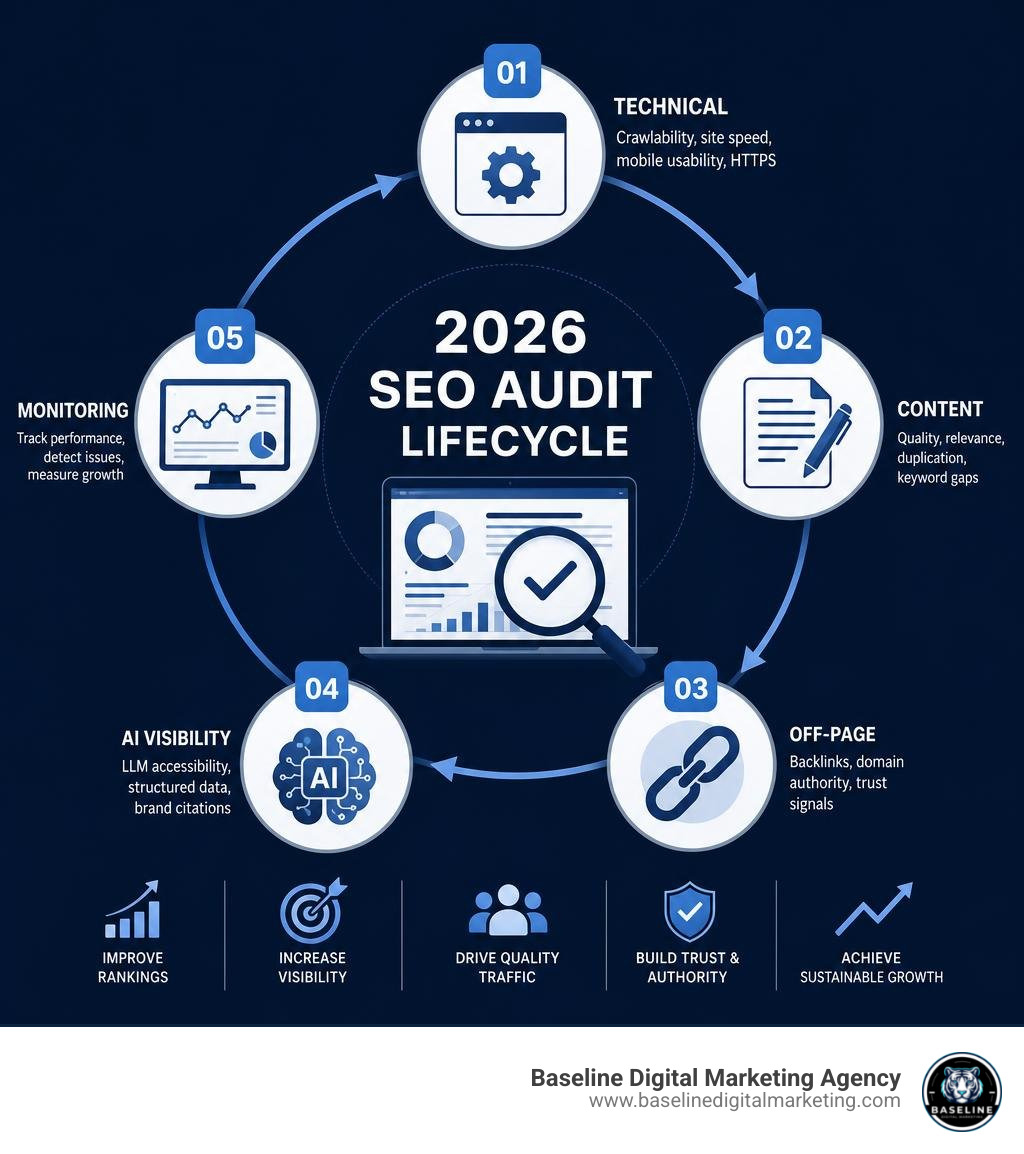
An SEO audit is a full checkup of your website — it finds the technical problems, content gaps, and missed opportunities that are quietly holding back your rankings.
Here’s what an SEO audit covers at a glance:
| Audit Area | What It Checks |
|---|---|
| Technical SEO | Crawlability, site speed, mobile usability, HTTPS |
| On-Page SEO | Title tags, meta descriptions, headings, keywords |
| Content | Quality, relevance, duplication, keyword cannibalization |
| Off-Page SEO | Backlinks, domain authority, trust signals |
| Local SEO | Business listings, reviews, local citations |
| AI Visibility | LLM accessibility, structured data, brand citations |
With 45.1% of all search clicks coming from organic results — and AI-powered search now capturing 40% of all queries — your website either shows up or it doesn’t. There’s very little middle ground.
The problem most small business owners face isn’t a lack of effort. It’s invisible technical debt — broken crawl paths, slow page loads, thin content, and missing schema markup — that quietly drains organic traffic while everything on the surface looks fine.
Sites without regular technical monitoring lose an average of 12% of their organic traffic every quarter just from issues piling up. That’s not a content problem. That’s a maintenance problem.
I’m Carlos Alvarez, founder of Baseline Digital Marketing Agency, and I’ve helped businesses across industries use the SEO audit process to uncover exactly why their websites underperform — and build a clear path to fix it. Let’s walk through everything you need to know.
What is a Website Audit and Why It Matters in 2026
The search landscape in June 2026 is vastly different than it was even a couple of years ago. Today, AI Overviews appear in over 50% of Google search results, and traditional organic clicks have shrunk to roughly 40.3% of US searches. Furthermore, with 40% of searches now happening directly in AI engines (like ChatGPT, Claude, and Perplexity), a traditional seo audit that only looks at meta tags and keyword densities is no longer sufficient.
If your audit process hasn’t evolved to evaluate how large language models (LLMs) crawl, parse, and cite your content, you are auditing for a search engine that no longer exists. A modern website audit must act as a bridge between traditional search engine optimization and Generative Engine Optimization (GEO).
When done correctly, an audit acts as a diagnostic health check. It ensures that search engine crawlers and AI bots can easily navigate your site, understand your content’s context, and recognize your brand’s authority. If you want to understand why standard, automated reports fail to move the needle, Ishaan Shakunt shares brilliant insights on Why most SEO audits are useless and how to do it right – LinkedIn . Real audits require strategic prioritization, not just a raw export of 500 minor errors from an automated tool.
The Core Types of seo audit Processes
To keep your website performing at its absolute peak, we categorize audits into five core areas. Trying to fix everything at once leads to analysis paralysis, so we recommend breaking your analysis down systematically.
| Audit Type | Core Focus | When to Run It | Key Benefit |
|---|---|---|---|
| Technical SEO | Crawlability, indexation, site speed, XML sitemaps, robots.txt | Every 3-6 months, or after major site migrations | Ensures search engines can discover and index your pages |
| On-Page SEO | Metadata, heading structures, URL hygiene, keyword alignment | Quarterly, or when launching new core services | Directly improves keyword relevance and click-through rates (CTR) |
| Off-Page SEO | Backlink quality, toxic links, brand mentions, authority signals | Bi-annually | Identifies spam risks and uncovers link-building opportunities |
| Content Audit | Content decay, keyword cannibalization, E-E-A-T, user intent | Annually | Pinpoints thin, duplicate, or outdated pages that need pruning |
| Local SEO | Google Business Profile, local citations, reviews, schema | Quarterly (for regional businesses) | Dominates local map packs and regional search queries |
Each of these audits plays a unique role in your digital growth. For instance, if you run a digital storefront, your priorities will skew heavily toward technical structure and indexation. To see how this applies to digital storefronts, check out our comprehensive guide on The Ultimate Ecommerce SEO Audit Checklist to Boost Sales.
How to Perform a Comprehensive Technical Audit
Technical SEO is the foundation upon which all other digital marketing efforts rest. You can write the most brilliant copy in your industry, but if Googlebot faces a crawl barrier, your content will remain completely invisible.
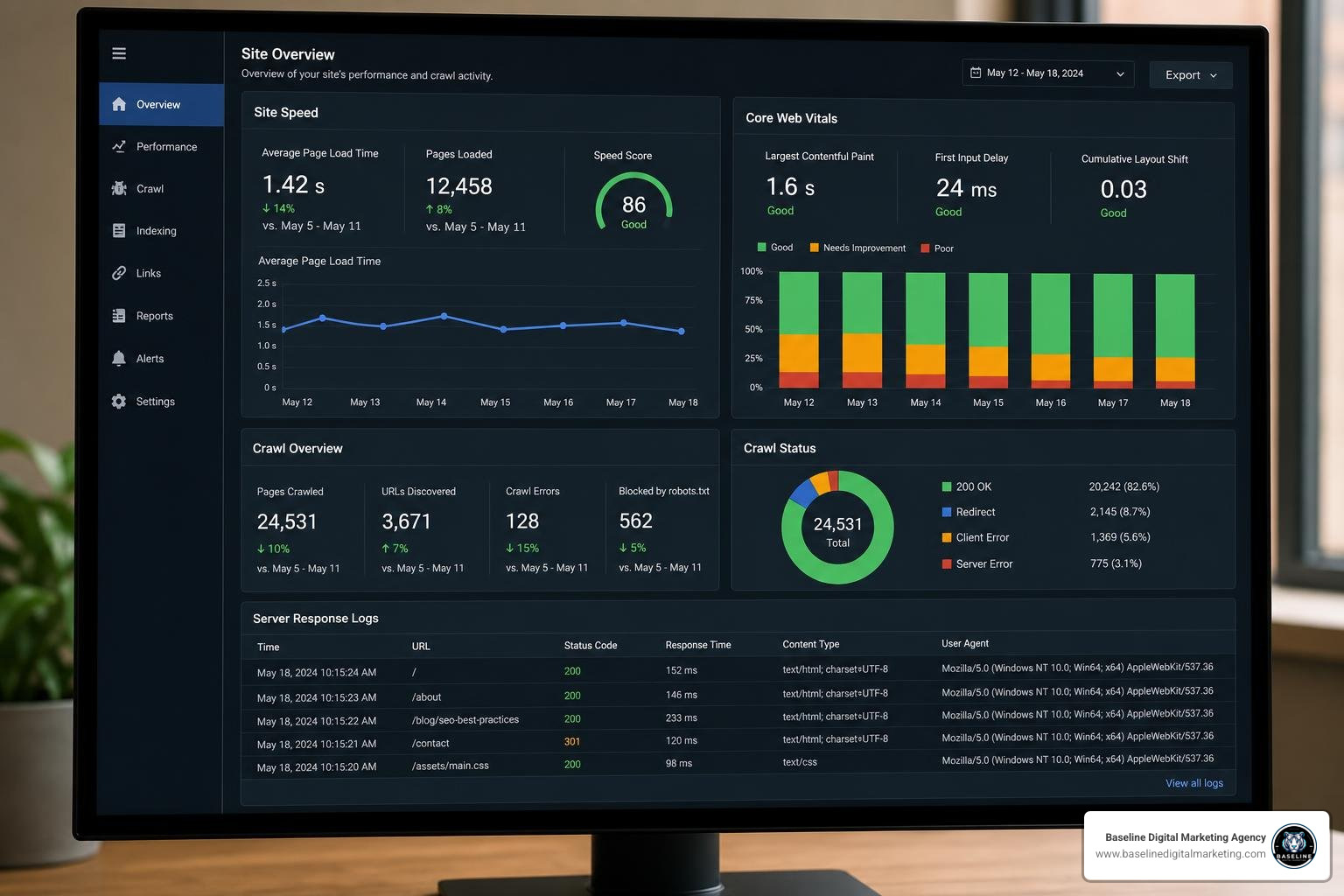
A comprehensive technical seo audit starts with an analysis of how bots interact with your server. We begin by checking your robots.txt file (located at yourdomain.com/robots.txt) to ensure you aren’t accidentally blocking critical CSS, JS, or high-value directories.
Next, we look at mobile usability. Mobile devices now account for 63% of organic search engine visits. Google operates entirely on mobile-first indexing, meaning it evaluates the mobile version of your site to determine rankings. If your mobile layout hides important content or has tiny touch targets, your desktop rankings will suffer too. For a deeper dive into protecting your mobile presence, read our guide to make sure you Don’t Let Your Mobile Rankings Go South.
Core Web Vitals and Site Speed Optimization
Google uses Core Web Vitals (CWV) as critical ranking signals that measure real-world user experience. When auditing site speed, we prioritize three main metrics:
- Largest Contentful Paint (LCP): Measures loading performance. To achieve a “Good” rating, your LCP must occur within 2.5 seconds of the page starting to load. Pages in the top LCP quartile see a 24% higher organic CTR than pages failing to meet this threshold.
- Interaction to Next Paint (INP): Measures page responsiveness. This metric replaced First Input Delay (FID) to better capture how quickly a page responds to user clicks, taps, or key presses. A good INP is 200 milliseconds or less.
- Cumulative Layout Shift (CLS): Measures visual stability. It tracks unexpected layout shifts while a page loads. A good CLS score is 0.1 or less.
To optimize these metrics, we recommend preloading your LCP images using in the document head, serving modern image formats like WebP or AVIF (which save up to 50% in page weight compared to JPEGs), and targeting a Time to First Byte (TTFB) of under 600ms using robust edge caching.
Crawl Budget, Duplicate Content, and Redirect Chains
Crawl budget refers to the number of pages search engine bots crawl on your website during a given timeframe. For smaller sites, crawl budget isn’t a major issue. However, sites with 10,000+ pages often lose up to 30% of their crawl coverage to duplicate, low-quality, or blocked URLs.
Common culprits that waste crawl budget include:
- Parameter Proliferation: Dynamic URLs generated by product filters or session IDs.
- Crawl Traps: Infinite scroll calendars or poorly configured internal search pages.
- Redirect Chains: When a crawler has to follow multiple redirects (e.g., URL A → URL B → URL C) to reach a destination. We must resolve these chains to direct 301 redirects to conserve link equity and crawl energy.
To resolve these, we implement self-referencing canonical tags on all unique pages and configure parameter handling rules within search consoles to prevent duplicate indexing.
Structured Data and Schema Markup Validation
Structured data (schema markup) helps search engines understand the explicit meaning of your content, making your site eligible for eye-catching rich results. Despite its massive benefits, only 17% of the top 10 million websites implement schema markup, creating an immediate competitive advantage for your business.
During your seo audit, verify that your core pages implement relevant schema types, such as:
OrganizationandLocalBusinessschema for brand identity.ProductandReviewschema to display pricing, availability, and star ratings in search results.ArticleorFAQPageschema to capture quick-answer boxes.
To ensure your structured data is error-free, validate it using Google’s Rich Results Test and the Schema Markup Validator.
Internal Linking and Site Architecture
Your site architecture determines how authority flows from your homepage down to your deepest subpages. A poorly structured site buries important content, making it difficult for both users and search engines to navigate.
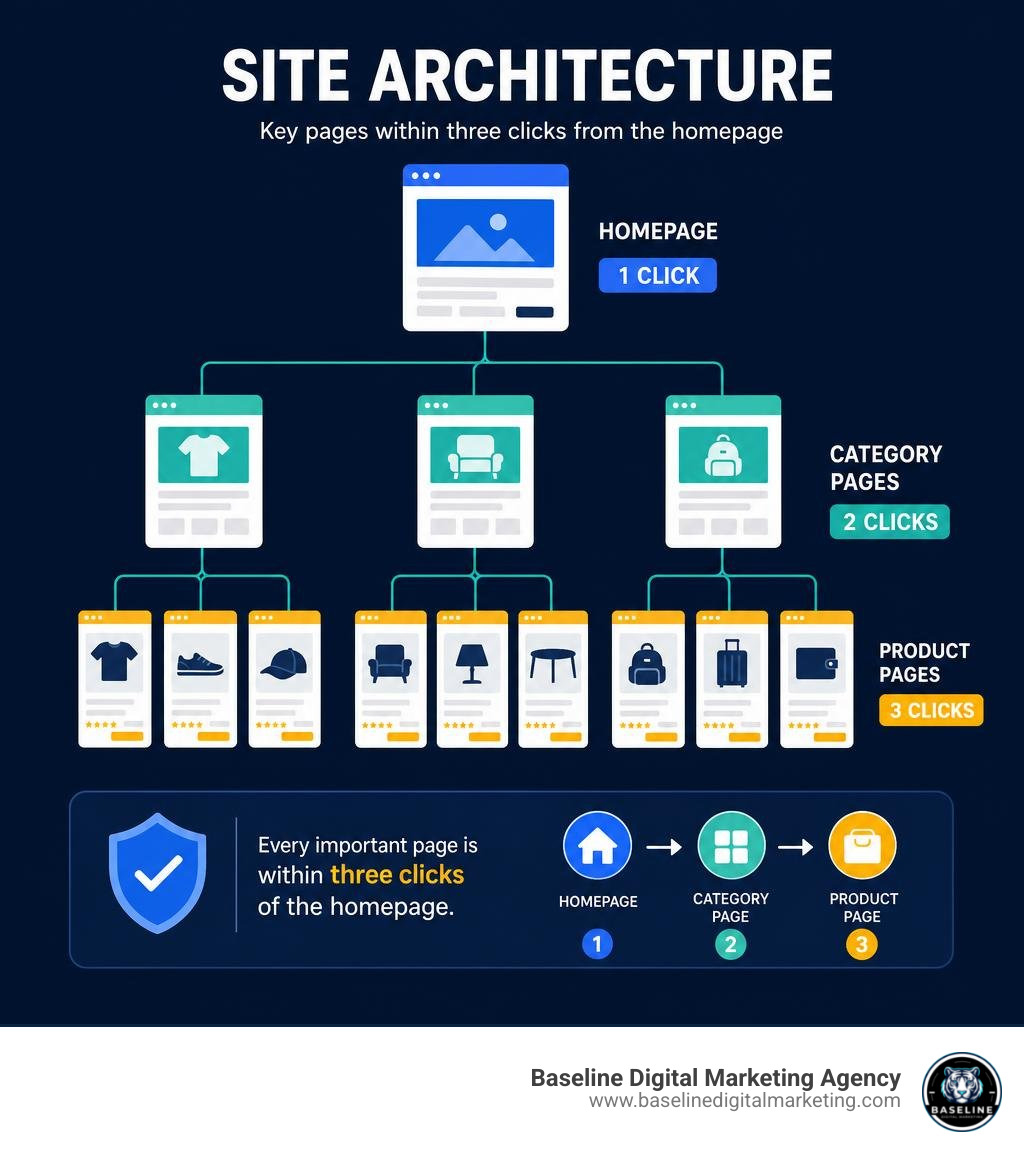
A systematic internal linking audit typically uncovers that 40% to 60% of pages have zero internal links pointing to them. These are known as “orphan pages.” Because they lack internal links, search engine bots rarely crawl them, and they distribute zero link equity.
To fix this, we ensure that every key revenue-driving page is situated within three clicks of the homepage. For a step-by-step breakdown of how to map your link equity and discover hidden ranking opportunities, check out our guide on Internal Linking Audit: How to Find Hidden Ranking Opportunities.
Website Security and HTTPS Protocols
Website security is a fundamental trust signal. Google has used HTTPS as a ranking signal for over a decade, and in 2026, browsers are incredibly strict about warning users away from insecure connections.
During the security phase of your audit, we check for:
- SSL Certificate Validity: Ensuring your certificate is active and properly configured.
- Mixed Content Issues: This occurs when an HTTPS page loads resources (like images, scripts, or stylesheets) over an insecure HTTP connection. Mixed content warnings can suppress your organic CTR by up to 45%.
- HSTS Implementation: Enabling the HTTP Strict Transport Security (HSTS) header (with a minimum
max-ageof 31,536,000 seconds) forces browsers to only interact with your site via secure HTTPS.
Optimizing for AI Search and Generative Engine Optimization (GEO)
As search behaviors shift, optimizing for AI engines is just as important as optimizing for traditional search results. LLM-driven platforms do not look at keywords the same way Google’s legacy algorithm does. Instead, they parse content for clear facts, structured data, and authoritative citations.
To improve your visibility in AI Overviews and LLM engines, we focus on several key optimization techniques:
- AEO-Friendly Page Patterns: Structure informational content using a “Summary → Steps → FAQs” pattern. Providing a direct, 40-to-60-word answer immediately following an H1 or H2 makes it incredibly easy for AI bots to extract your content as a direct citation.
- Bot Access Management: Ensure your robots.txt file does not accidentally block AI crawlers like
GPTBotorClaudeBotif you want your brand to be recommended in conversational search queries. - Data Citations: Back up your claims with reputable data sources. AI engines prioritize citing websites that reference verified facts and structured statistics.
If you want to ensure your brand is visible across all digital touchpoints—from Google to ChatGPT—learn more about our specialized Service: Search Everywhere Optimization.
Selecting the Best seo audit Tools
Choosing the right toolset depends entirely on your site’s scale, your technical expertise, and your business goals. To help you navigate the landscape, you can read Zapier’s review of The 9 best SEO audit tools | Zapier .
For quick, high-level overviews, you can start with A Free SEO Audit Tool by Ahrefs , which provides excellent crawl reports and flags on-page errors for up to 5,000 pages per month. If you are auditing a brick-and-mortar business, a localized analysis tool is essential; we highly recommend reading How to: Local SEO Audit & Competitive Analysis | Uberall to master regional search optimization.
Setting Up an Ongoing seo audit Schedule
An seo audit is not a one-time project; it is ongoing infrastructure maintenance. Websites are dynamic environments—plugins update, content editors upload uncompressed images, and developers push code changes that can inadvertently break canonical tags or crawl directives.
We recommend the following cadence to prevent performance regressions:
- Weekly: Automate basic technical health crawls to flag broken links (404 errors) or sudden crawl anomalies.
- Monthly: Review Google Search Console indexation reports and Core Web Vitals trends.
- Quarterly: Conduct a comprehensive technical and on-page audit.
- Annually: Perform a deep-dive content pruning and competitive gap analysis.
Common Technical Mistakes to Avoid
Over the years, we have seen perfectly good websites lose massive amounts of organic traffic due to simple, overlooked technical issues. When performing your audit, pay close attention to these common pitfalls:
- Index Bloat: This occurs when search engines index hundreds of low-value, thin, or duplicate pages (such as WordPress tag pages, search result pages, or print-friendly URLs). This dilutes your site’s overall authority and wastes crawl budget.
- Staging Environment Indexation: Forgetting to add a
noindextag or basic authentication to a staging site can lead to Google indexing your entire development environment, resulting in massive duplicate content issues. - Keyword Cannibalization: When you have multiple pages targeting the exact same keyword search intent, they end up competing against each other in the search results, dragging down the rankings of both pages.
- Incorrect Canonical Tags: Pointing canonical tags to broken URLs, redirecting URLs, or legacy HTTP protocols confuses search engines and ruins your link equity distribution.
Frequently Asked Questions About Website Audits
How often should I run a technical website audit?
We recommend running a comprehensive technical audit every 3 to 6 months. However, if your team is pushing code updates weekly or regularly publishing large volumes of content, you should set up automated weekly crawl monitoring to catch issues before they impact your rankings.
What is the difference between noindex and disallow in robots.txt?
This is one of the most common points of confusion in technical SEO:
- Disallow in robots.txt tells search engine bots they are not allowed to crawl a specific URL or directory. However, if that blocked page has backlinks pointing to it, Google may still index the page—it just won’t know what content is on it.
- Noindex (via a meta tag or HTTP header) tells search engines they are allowed to crawl the page, but they must not index it or show it in search results. If you want a page completely kept out of search results, use a
noindextag, not adisallowdirective.
Can a website audit help improve my visibility in AI search engines?
Absolutely. Modern audits check for AI readiness by analyzing schema markup coverage, bot accessibility (making sure GPTBot and ClaudeBot aren’t blocked), structured heading trees, and clear, extractable content layouts. Ensuring your technical and schema structures are flawless is the single best way to secure brand citations in generative AI search results.
Conclusion
An seo audit is the ultimate roadmap to unlocking your website’s hidden potential. By systematically identifying and resolving technical debt, improving site speed, structuring content for AI engines, and building a clean internal linking architecture, you lay a solid foundation for sustainable, long-term organic growth.
At Baseline Digital Marketing Agency, we don’t believe in running automated, generic reports and calling it an audit. We build customized, high-impact search strategies tailored to your unique business goals. Whether you want to dominate traditional Google rankings or optimize your brand for the generative AI search revolution, we are here to help.
Ready to take your online presence to the next level? Explore our comprehensive A-Z Guide to SEO Services or check out our full range of digital growth solutions on our Services page. Let’s build something great together.