
Why Most Backlinks Don’t Move Your Rankings (And What Does)
Contextual link building is the practice of earning backlinks placed naturally inside the body content of relevant, published articles — surrounded by text that relates directly to your topic.
Here’s a quick breakdown of what that means in practice:
| Question | Answer |
|---|---|
| What is a contextual link? | A hyperlink embedded inside a paragraph of relevant content on another website |
| Why does it matter? | It sends stronger relevance signals to Google than links in footers, sidebars, or directories |
| How is it different from a regular backlink? | All contextual links are backlinks, but not all backlinks are contextual |
| What makes one high quality? | Topical relevance, editorial placement, natural anchor text, and a site with real traffic |
| What are the best strategies? | Digital PR, broken link replacement, niche edits, and guest contributions |
Here’s something most small business owners don’t realize: it’s not how many backlinks you have — it’s where they’re placed and how relevant they are.
A single link tucked inside a well-written, relevant article can outperform a dozen links sitting in website footers or random directories. That’s not an opinion. Research consistently shows that in-content links pass more authority, drive more clicks, and hold up better through Google algorithm updates.
Google’s own systems — including SpamBrain and its Helpful Content evaluation — are now very good at telling the difference between a link that was placed because it genuinely helps a reader, and one that was dropped there just to game rankings.
The gap between those two types of links is getting wider every year.
I’m Carlos Alvarez, founder and CEO of Baseline Digital Marketing, and contextual link building has been a core pillar of the SEO strategies I’ve developed for businesses across industries. In this guide, I’ll walk you through exactly how it works — and the three strategies that consistently deliver results.
Key terms for contextual link building:
Demystifying Contextual Link Building: The Gold Standard of SEO
To truly understand why Google values some links more than others, we have to look at the internet from the search engine’s perspective. When search engine crawlers scan a webpage, they don’t just look at a hyperlink in isolation. They analyze the words, sentences, and paragraphs surrounding that link. This is where the magic of contextual link building comes into play.
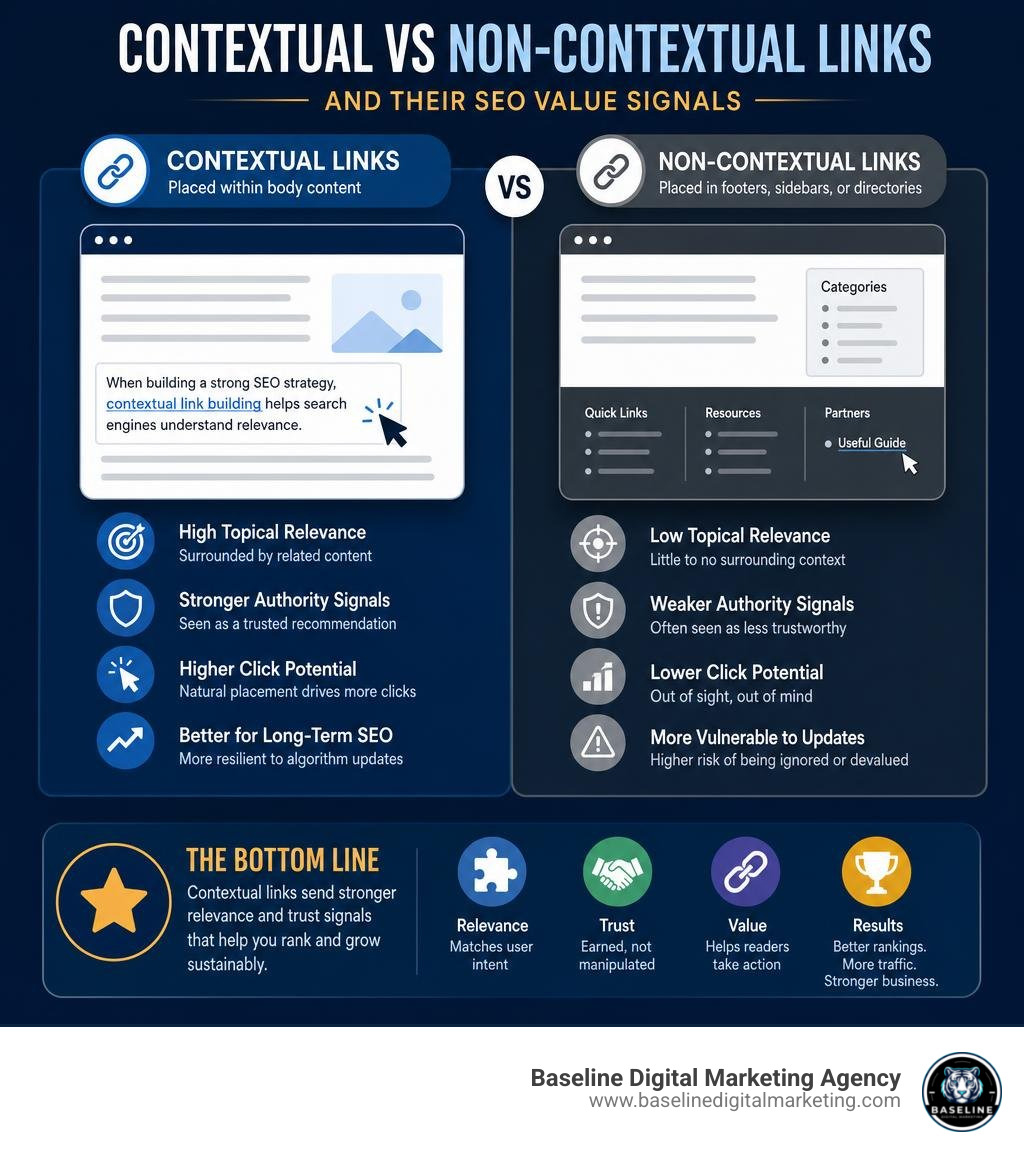
A contextual link is a hyperlink embedded directly within the editorial body of a webpage. It is surrounded by relevant, informative copy that naturally leads the reader to click for more information. This is fundamentally different from non-contextual links, which typically reside in sidebars, author bios, footers, or massive directory listings.
To understand the differences, let’s look at this comparison:
| Feature | Contextual Links | Non-Contextual Links |
|---|---|---|
| Placement | Main body copy of an article or blog post | Footers, sidebars, author bios, or directories |
| Surrounding Text | Highly relevant, semantically related copy | Boilerplate text, navigation links, or no text at all |
| User Experience (UX) | High; offers natural next steps for interested readers | Low; often ignored or seen as disruptive |
| Search Engine Weight | Maximum link equity transfer | Minimal or discounted link equity |
| Risk Profile | Extremely low (resilient to spam updates) | High (vulnerable to automated filter penalties) |
According to industry data, in-content links get 3 to 5 times more clicks than footer or sidebar links. This directly impacts user experience—and since 67% of SEOs agree that user experience is a major factor in Google ranking, the UX value of contextual links cannot be overstated.
When you build these natural pathways, search engines use natural language processing (NLP) to read the semantic relationship between the linking page and your target page. If you want to dive deeper into how search systems evaluate these connections, you can read more about what makes a link truly context-rich in this guide on What Is Contextual Link Building – Medium.
In the past, SEO was often treated as a numbers game where the site with the most backlinks won. Today, Google’s algorithms are highly sophisticated. They look at the “relevance stack”—evaluating the domain topic, page topic, paragraph topic, and anchor wording to ensure the connection is genuine. For a complete look at how this fits into a broader marketing campaign, check out our comprehensive A-Z Guide to SEO Services.
A contextual link acts as an editorial endorsement. It tells Google: “This resource is so valuable to the topic we are discussing that we are sending our readers directly to it.” This editorial relationship is what makes contextual links so powerful for search engine optimization, signaling genuine trust and authority.
The Anatomy of a High-Quality Contextual Link

Not all contextual links are created equal. Just because a link sits inside the body text of an article does not automatically make it a high-quality ranking signal. To ensure your link building efforts yield the highest return on investment, you must understand the core anatomical elements of a perfect contextual link.
- Topical Relevance: The linking page must share a strong semantic connection with your target page. If a pet food blog links to a financial planning website, the context is broken, and Google will likely discount the link equity.
- Domain Authority and Real Traffic: A link from a site with a high Domain Rating (DR) but zero organic traffic is a red flag. High-quality links come from active, authoritative websites that real humans visit and read.
- Natural Anchor Text: The clickable text of the link must fit seamlessly into the sentence. It should describe what the reader will find when they click, without being stuffed with exact-match keywords.
- Micro-Placement: Google’s “Centerpiece Annotation” system identifies the main content area of a page. Links placed higher up in the body copy generally carry more weight because they are more likely to be seen and clicked by users.
- User Intent Alignment: The link must satisfy the reader’s intent. If the surrounding text discusses “how to calculate mortgage interest,” the link should point to a calculator or a deep-dive guide on that exact topic.
To understand how these elements function in a live web environment, you can read more about the technical structure of hyperlinks in this piece on What Are Contextual Hyperlinks » GetSocialGuide – Grow & Monetize Your WordPress Blog With Social Media.
Internal Contextual Link Building: Maximizing Your Existing Assets
Before spending time and resources on external outreach, we always recommend looking inward. Your own website is a goldmine of untapped link equity. Internal contextual linking is the process of connecting your own pages within your body content to build logical topic clusters.
By linking from your high-authority blog posts to your core service or product pages, you distribute “link juice” evenly across your site. This helps search engines crawl your content more efficiently and understand which pages are the most important. To find these hidden ranking opportunities on your site, we recommend conducting a structured Internal Linking Audit: How to Find Hidden Ranking Opportunities.
Outbound and Inbound Contextual Links
A healthy, natural link profile requires a balance of three link directions:
- Inbound Contextual Links: These are links from external websites pointing to your content. They are the primary driver of domain authority and search visibility.
- Outbound Contextual Links: These are links from your content pointing to external, authoritative resources (like research studies, government databases, or industry leaders). Linking out to trusted sources builds credibility and signals to Google that your content is thoroughly researched.
- Internal Contextual Links: As discussed, these connect your own content assets to keep users engaged and pass equity internally.
To see how your current link profile balances these three directions, you can use our step-by-step Detailed SEO Audit Guide: Stop Guessing and Start Ranking.
3 Powerful Contextual Link Building Strategies for 2026

Now that we have covered the theory, let’s dive into the practical execution. As we navigate 2026, Google’s AI-driven spam detection systems—most notably SpamBrain—have made old-school, manipulative link tactics obsolete. To succeed today, your link building must be editorial, human-vetted, and value-first. Here are the three most effective strategies you can execute to earn links that Google will love.
Strategy 1: Digital PR and Data-Driven Content Assets
The single most effective way to earn high-authority contextual links at scale is through Digital PR. This involves creating “linkable assets”—highly valuable, original content that journalists, bloggers, and industry analysts naturally want to reference.
The most successful linkable assets include:
- Original Research and Surveys: Conducting a survey in your niche and publishing the unique data.
- Free Interactive Tools: Building calculators, templates, or simple software that solves a specific problem.
- In-Depth Industry Guides: Creating the definitive “ultimate guide” on a complex topic. (Long-form written content generates an average of 77.2% more links than short articles).
Once your asset is live, you can leverage platforms like Connectively (formerly HARO) to connect with journalists looking for expert quotes and data points. With over 75,000 journalists submitting more than 50,000 queries a year, this remains a goldmine for earning contextual links from major news outlets.
Because AI is rapidly changing how content is created and sourced, it is also crucial to understand how modern search systems crawl these assets. Read our analysis on How Generative AI is Rewriting the Rules of SEO to ensure your digital PR strategy remains future-proof.
Strategy 2: Broken Link Replacement and Niche Edits
If you do not have the resources to launch a massive Digital PR campaign, broken link building and niche edits (also known as link insertions) are highly effective alternatives.
The process for broken link building is straightforward:
- Use an SEO tool like Ahrefs or Semrush to find resource pages or blog posts in your niche that contain broken links (404 errors).
- Create a high-quality piece of content that serves as a perfect replacement for the broken resource.
- Reach out to the website owner, politely alert them to the broken link, and offer your newly created content as a replacement.
Because personalized emails improve click-through rates by 14% and conversion rates by 10%, taking the time to write a custom, friendly pitch to the site editor will dramatically increase your success rate.
Niche edits follow a similar logic but focus on active, healthy pages. You find articles that are already ranking and indexing well, then pitch the editor to add a sentence or paragraph that naturally includes a contextual link to your site. This is highly effective because the linking page already has established authority. If you are a local business, this tactic works incredibly well when targeting local community blogs, directories, and regional news sites. Learn how to map out this local approach with our Practical Guide to Local SEO.
Strategy 3: Guest Contributions with Entity-Based Contextual Link Building
Guest blogging is one of the oldest link building strategies, but in 2026, it requires a modern twist: entity-based optimization.
Google’s search engine no longer just looks at strings of text; it looks at “entities”—uniquely identifiable concepts, brands, people, and places. When writing guest contributions for authoritative websites in your industry, do not just drop a link with an exact-match keyword anchor. Instead, focus on entity co-occurrence.
This means placing your brand name, your primary topic keywords, and related industry concepts in close proximity to your contextual link. For example, if your business is a SaaS platform for HR teams, your link should be surrounded by semantically related entities like “employee retention,” “onboarding workflows,” and “payroll integration.” This tells Google’s natural language processing models that your site is a recognized authority within that specific entity cluster.
Frequently Asked Questions about Contextual Links
Navigating link building can raise a lot of questions. Here are the answers to the most common queries we receive about contextual links.
How long does it take to see results from contextual links?
Most businesses begin to see measurable ranking movement within 1 to 6 months of acquiring high-quality contextual links, with the average sitting around 3 months. The exact timeline depends on the competitiveness of your niche, the authority of the linking domain, and how quickly Google indexers crawl and register the new placement.
Are paid contextual links safe for SEO?
Buying low-quality, automated links from link farms or public blog networks (PBNs) violates Google’s guidelines and will likely result in a manual action or algorithmic penalty. However, investing in manual outreach, digital PR campaigns, or editorial placement services that vet sites for real traffic and high standards is a safe, standard industry practice. Always prioritize quality, relevance, and human-editorial review over cheap, bulk link packages.
What is the difference between a contextual link and a regular backlink?
All contextual links are backlinks, but not all backlinks are contextual. A regular backlink can sit anywhere on a website, such as a site-wide footer link or an isolated sidebar widget, with little to no surrounding text. A contextual link is placed specifically within the editorial body of a page, surrounded by highly relevant sentences that provide clear semantic meaning to both readers and search engines.
Conclusion
In the modern digital landscape, search engines are smarter than ever. They can easily separate empty, manipulative links from genuine, helpful editorial recommendations. If you want to build long-term search visibility, increase your domain authority, and protect your website from future algorithm updates, contextual link building is not optional—it is the foundation of modern SEO success.
By focusing on high-quality content creation, strategic manual outreach, and semantic relevance, you can build a link profile that search engines trust and reward.
At Baseline Digital Marketing Agency, we develop comprehensive digital strategies, deliver cutting-edge SEO, build high-performing websites, and provide branding services to help your business grow its online presence. If you are ready to scale your organic rankings and drive high-intent referral traffic to your site, Grow your online presence with Baseline Digital Marketing Agency today. Let’s build a digital presence that search engines and users will love.