Why Skipping Buyer Personas in a Website Redesign Is a Costly Mistake
A website redesign buyer persona is a research-based profile of your ideal customer — built to guide every design, content, and navigation decision on your new site.
Quick answer: What is a website redesign buyer persona and why does it matter?
| Element | What It Means for Your Redesign |
|---|---|
| Who it is | A fictional but data-backed profile of your ideal customer |
| What it includes | Demographics, goals, pain points, FAQs, buying behavior |
| Why it matters | Websites built around personas are 2-5x more effective |
| What happens without it | Misaligned content, wasted budget, high bounce rates |
| First step | Research before you touch a single wireframe or color palette |
Most small business owners start a website redesign by talking about fonts, colors, and layouts. That’s understandable — visual changes are exciting and easy to see.
But here’s the problem: a beautiful website that speaks to no one converts no one.
According to research, 94% of first impressions are tied to design — but design alone won’t save you if the content, navigation, and messaging aren’t built around the people you’re actually trying to reach.
One certification organization redesigned its website around four specific audience types. The result? A 265% increase in traffic within 10 months — not from a bigger budget or a fancier design, but from finally speaking directly to the right people.
That’s the power of starting with personas instead of pixels.
I’m Carlos Alvarez, founder of Baseline Digital Marketing Agency, and I’ve helped businesses across multiple industries align their website redesign buyer persona strategy with real growth goals — combining my background in executive leadership, sales strategy, and digital marketing to drive results that actually move the needle. In this guide, I’ll walk you through exactly how to build and use buyer personas so your next redesign works with your audience, not against it.
Terms related to website redesign buyer persona:
What is a Website Redesign Buyer Persona and Why Does It Matter?
Before we dive into wireframes and color schemes, we must establish what a website redesign buyer persona actually is. It is not a superficial list of demographics or a generic profile of “anyone who might buy from us.” Instead, it is a highly detailed, data-backed archetype of your ideal customer, built using real customer interviews, analytics, and sales feedback.
When we engage in user-centered design, we shift the focus away from what we think looks good and place it squarely on what your target audience needs to see, read, and experience. Research shows that 46.1 percent of people say a website’s design is the number-one criterion for discerning the credibility of a company. If your design fails to connect with who your buyers are, you instantly lose that credibility.

To build deep trust, we have to understand the core attributes of our users, which are outlined in What Are User Personas & Why Are They Important to Your Website. These attributes include:
- Demographics: Age, job title, industry, and decision-making authority.
- Psychographics: Values, professional challenges, personal motivations, and career goals.
- Webographics: How tech-savvy they are, which devices they use, and where they consume information.
- Pain Points: The specific friction points or problems that keep them up at night.
By defining these elements before a single pixel moves, we ensure the new website speaks directly to their needs.
Aligning Business Goals with Your Website Redesign Buyer Persona
A common trap in website development is the tug-of-war between business objectives and user needs. The executive suite might want to showcase a new corporate vision, while the sales team wants a massive contact form, and the marketing team wants to push a new product line.
The secret to a highly successful redesign lies in finding the “sweet spot” where your business goals and buyer needs intersect.
For example, if your business goal is to increase qualified sales pipeline, but your buyer’s need is to quickly compare product capabilities without jumping through hoops, the sweet spot is a transparent, highly interactive comparison tool that leads to a frictionless demo booking page. When you align these needs, you maximize your marketing-influenced wins. To ensure these strategies are executed consistently across every page of your site without starting from scratch, we highly recommend utilizing a cohesive system, as detailed in our guide on Why Your Website Redesign Needs a Design System.
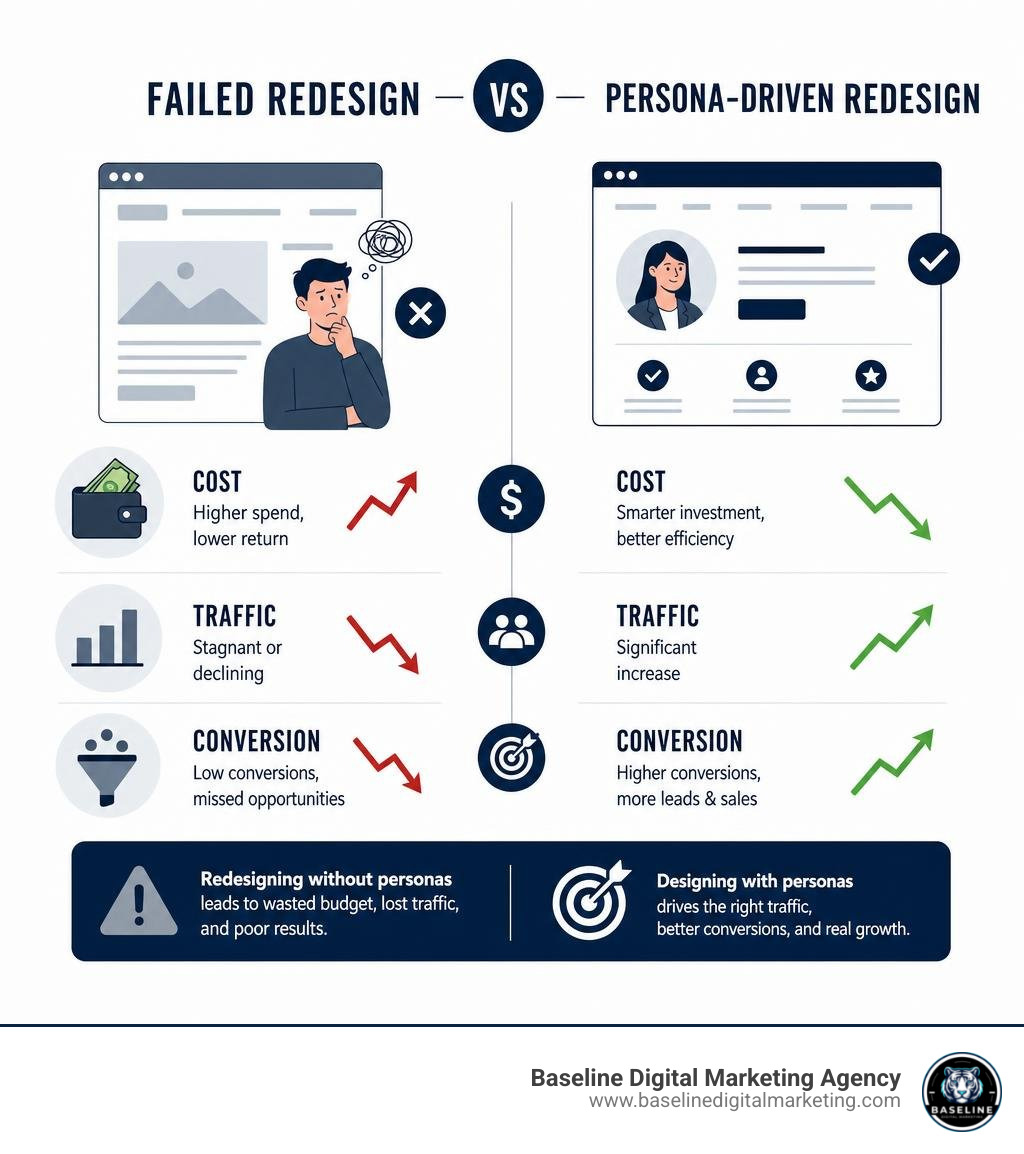
The Cost of Going Blind: Redesigning Without a Website Redesign Buyer Persona
Redesigning a website without a clear website redesign buyer persona is like building a house without a blueprint. You might end up with a beautiful structure, but the kitchen is in the attic and the front door won’t open.
When organizations build sites based on internal opinions rather than buyer data, they fall victim to several common mistakes:
- Misaligned Goals: The site is optimized for vanity metrics (like raw traffic) rather than commercial actions (like qualified lead submissions).
- Subjective Design Decisions: Design reviews devolve into debates over whether the CEO likes the color blue, rather than whether the buyer finds the layout easy to navigate.
- High Bounce Rates: Visitors land on the homepage, fail to understand what you do within the first five seconds, and immediately leave to visit a competitor.
- Wasted Budget: You spend months and tens of thousands of dollars building complex features that your actual buyers never use.
In short, a blind redesign is a fast track to a website that looks pretty but performs poorly.
How Buyer Personas Drive Usability, Conversions, and ROI
When you ground your redesign in buyer persona research, the website stops being a static digital brochure and becomes a dynamic revenue infrastructure.
Let’s look at the quantitative differences between a generic redesign and a persona-driven redesign:
| Metric | Generic Redesign Focus | Persona-Driven Redesign Focus |
|---|---|---|
| Primary Goal | Aesthetic refresh and modern look | Solving buyer pain points and guiding user paths |
| Site Usability | Built around internal org charts | Built around buyer search intent and intuitive UX |
| Conversion Rates | Generic “Contact Us” buttons on every page | Tailored CTAs matching different readiness stages |
| Traffic Growth | Broad keyword targeting | Highly targeted commercial-intent search terms |
| ROI Impact | Minimal conversion lift; high bounce rates | 2-5x increase in website effectiveness and pipeline |
According to HubSpot, using marketing personas makes websites 2 to 5 times more effective and significantly easier to use. Furthermore, inbound marketing methods—which rely on persona-aligned content—yield three times more leads per dollar than traditional marketing. If you want to understand the strategic foundation of this approach, check out Understanding Your Audience: Why You Need Buyer Personas, which highlights how persona-driven optimization directly feeds your sales funnel.
Optimizing Navigation and Information Architecture
Navigation is the map of your website. If it is confusing, your visitors will get lost and leave. Studies show that 86 percent of visitors want to see information about a company’s products or services directly on the homepage, and they expect to find it quickly.
By analyzing your website redesign buyer persona, we can structure your navigation based on how your buyers actually think. Instead of labeling your main menu with internal product names or technical jargon, we organize it by:
- By Role: “For Marketers,” “For Developers,” “For IT Leaders.”
- By Use Case: “Compliance Management,” “Workflow Automation.”
- By Industry: “Healthcare,” “Finance,” “SaaS.”
This persona-centric architecture ensures that different user segments can self-identify and find their specific path within seconds of landing.
Furthermore, we must design with a mobile-first mindset. Since 2017, mobile devices have generated over 50% of all website traffic. Decreasing mobile site load times by just 1/10 of a second increases conversion rates by up to 10%. A persona-driven navigation system simplifies the mobile interface, stripping away unnecessary desktop clutter so on-the-go buyers can convert effortlessly.
Tailoring Content and Imagery to Persona Needs
Every buyer persona has unique questions, objections, and visual preferences. A design-oriented buyer might prioritize high-quality product screenshots and interactive walk-throughs, while a analytical CFO persona will look for ROI calculators, security certifications, and case studies.
During the copy rounds of a redesign, we translate your brand’s positioning into page-level messaging that addresses these specific differences. We write copy that:
- Leads with the buyer’s problem in plain, jargon-free language.
- Offers a clear outcome statement backed by proof.
- Addresses hidden objections directly on the page (e.g., implementation timelines, pricing transparency, or migration support).
We also place social proof elements—like customer logos, video testimonials, and data points—right alongside the specific claims they validate, rather than hiding them on a single, generic “Testimonials” page.
Step-by-Step: Building and Operationalizing Personas for Your Redesign
Now that we know why personas are essential, let’s look at how to build and implement them step-by-step.

To build a robust buyer persona, you must gather real data rather than relying on assumptions. You can learn the practical mechanics of this process in How to Create a Better Buyer Persona, which offers a structured methodology for gathering qualitative and quantitative insights.
Once your research is complete, you can leverage our structured approach in The Complete Guide to Website Redesign Services to translate those insights into a fully developed website architecture.
Mapping the Buyer Journey and Creating Message Maps
Once your personas are defined, we map their customer scenarios. A scenario is a specific task or journey a buyer wants to accomplish on your site.
For each persona, we create a Buyer Decision Brief that answers:
- What is their primary trigger for seeking a solution?
- What are their top three questions when they land on our site?
- What are their primary objections to our product or service?
- What call-to-action (CTA) matches their current stage of readiness?
We then assign every major page on the new site a specific Buyer Decision Job. A product page might have the job to clarify and validate, while a case study page has the job to reassure and prove, and a pricing page has the job to reduce conversion hesitation.
This structure forms your conversion spine—a logical flow of information and CTAs that guides the user naturally from educational content to commercial action.
Auditing and Updating Content Based on Personas
A website redesign is the perfect opportunity to clean up your content library. Instead of migrating every old blog post and service page, we perform a persona-driven content audit:
- Inventory All Existing URLs: Use tools like Screaming Frog to crawl your site and list every indexable page.
- Evaluate Persona Relevance: Tag every page with the specific persona it targets. If a page doesn’t serve a clear persona or answer a specific buyer question, flag it for deletion or consolidation.
- Map Keyword Intent: Ensure your pages target the exact words and phrases your buyers use when searching. This protects your organic rankings and aligns with modern semantic search.
- Optimize for AI Search Discoverability: In June 2026, buyers increasingly use AI tools like ChatGPT, Claude, and Gemini to compare vendors. We format your content with clean semantic HTML, schema markup, and clear tables so AI engines can easily read, summarize, and recommend your business.
- Implement SEO Protection: Create a strict 1-to-1 redirect map for any URLs that are changing, ensuring you preserve your existing search equity and avoid broken links.
Balancing Stakeholder Demands with Buyer Needs
One of the hardest parts of managing a website redesign is navigating internal politics. Every department has its own wishlist, and without a clear framework, the website can quickly become a cluttered mess of competing internal priorities.
To keep the project on track, we use a Value vs. Effort Matrix to prioritize requests:
We evaluate every internal request by asking: “Which buyer persona’s question does this answer, and how does it make their decision easier or more confident?”
If an internal request cannot be mapped to a specific buyer need, it is deprioritized. By weighting buyer needs at two to three times the value of internal opinions, you build a streamlined, high-converting website that serves your customers first and your internal teams second.
Frequently Asked Questions about Persona-Driven Redesigns
How do you measure the success of a persona-driven website redesign?
We measure success by tracking buyer movement metrics rather than just raw traffic. These include conversion rate improvements on high-intent pages, increased engagement depth on key feature pages, an increase in qualified sales pipeline sourced directly from the site, and warmer sales calls where prospects already understand your value proposition. We configure GA4 tracking before launch to establish a clear baseline and measure these shifts accurately.
How many buyer personas should you focus on during a website redesign?
For most businesses, we recommend focusing on one primary persona and two to three secondary personas. Trying to build a website that appeals to ten different audiences results in generic, watered-down messaging that connects with no one. Keep your focus narrow to maximize your impact.
How often should you update your website buyer personas?
Your buyer personas should be treated as living documents. We recommend reviewing and updating your personas at least once a year, or whenever your business introduces a new product line, targets a new industry vertical, or experiences a shift in market dynamics. Continuous optimization ensures your website remains highly relevant.
Conclusion
A successful website redesign is not an aesthetic luxury; it is a critical revenue project. When you build your site around a clearly defined website redesign buyer persona, you eliminate internal guesswork, protect your hard-earned SEO rankings, and create a highly intuitive experience that guides your ideal customers from initial curiosity to a confident purchase.
At Baseline Digital Marketing Agency, we specialize in developing comprehensive digital strategies, SEO architectures, and custom website development built on deep audience research. We don’t just design beautiful websites—we build conversion-focused digital engines that drive measurable growth for your brand.
Let’s build a high-converting website for your brand and turn your digital presence into your most powerful sales asset.