Your Creative Agency Website Is Either Winning Clients or Losing Them
A well-designed creative agency website is one of the most powerful business development tools you have — and most agencies get it wrong.
Here are the key elements that make a creative agency website work:
- Strong first impression — visitors decide in seconds whether to stay or leave
- Clear brand personality — your site should show who you are, not just what you do
- Proof of work — case studies and results that build trust fast
- Simple navigation — visitors should find what they need without thinking
- One clear next step — a contact form, a call button, or a “Start a project” CTA
Most agency sites are visually impressive but fail to convert visitors into actual clients. They prioritize looking good over being useful — and that gap is exactly where potential clients slip away.
The good news? The agencies doing this well follow a repeatable set of design and content patterns. This article breaks those patterns down so you can apply them to your own site.
I’m Carlos Alvarez, founder and CEO of Baseline Digital Marketing Agency, where I’ve helped businesses build creative agency websites that are designed not just to impress — but to generate real leads. In the sections below, I’ll walk you through exactly what the best agency sites do differently and how you can put those lessons to work.
What Makes a Creative Agency Website Stand Out in 2026?
In 2026, the digital landscape is more crowded than ever. A pretty portfolio page is no longer enough to secure high-value clients. To truly stand out, a creative agency website must master the art of visual storytelling while delivering an effortless user experience.
The most successful agency websites don’t just list their services; they project a distinct brand personality. When a prospect lands on your site, they should immediately feel the energy, culture, and unique perspective of your team. This connection is critical because modern business growth is deeply tied to brand advocacy. In fact, industry data shows that 81% of year-on-year growth is correlated with strong brand advocacy.
Furthermore, 80% of consumers say they’ve discovered brands they like as a result of their fandom. If your website can cultivate a sense of “fandom” and community around your creative vision, you turn casual visitors into passionate advocates.
Another shift we have observed in 2026 is the complete decentralization of the creative industry. As highlighted in this piece on Why Location No Longer Matters For Advertising Agencies, physical office locations have taken a backseat to digital capabilities and global cultural intelligence. Your website is your true global headquarters. If your digital storefront feels outdated or generic, clients will assume your creative work is too.
To make sure your redesign hits the mark, you must design with your ideal clients in mind. We always recommend starting with a deep dive into your target audience’s pain points. To avoid common pitfalls during this phase, check out our guide on Don’t Redesign Blind: How Buyer Personas Save Your Website from Flop Status.
5 Essential Design Trends for Agency Sites
To capture attention in 2026, your site needs to balance cutting-edge aesthetics with functional layouts.

Here are the five most effective design trends and patterns we are seeing on top-performing agency websites today.
1. Immersive Showreels and Motion Design
First impressions are formed in milliseconds. Leading agencies use high-impact, short-form video showreels directly in their hero sections to showcase their capabilities instantly. However, the trend in 2026 goes beyond static video backgrounds.
Top sites use interactive micro-interactions, such as custom cursors that react to hover states, video playbacks triggered by scrolling, and seamless transitions between pages. These subtle movements keep users engaged longer and demonstrate technical execution without saying a single word. For a visual deep dive into how these elements come together, check out this video on 6 SHOCKINGLY Good Agency Websites – YouTube.
2. Bold Typography and Minimalist Layouts
Clean, ultra-minimalist structures paired with massive, custom typography are dominating agency web design. By embracing whitespace, you allow your creative assets to breathe and direct the user’s eyes exactly where you want them to go.
This approach establishes a clear visual hierarchy, ensuring your core messaging isn’t lost in a sea of unnecessary decorative elements. If you want to learn more about how bold branding choices translate to digital success, read The Non-Boring Guide to E-commerce Branding Strategies.
3. Interactive Case Studies and Proof of Work
The standard “grid of static images” is dead. Today’s clients want to see the story behind the results. Interactive case studies that feature horizontal scroll animations, before-and-after sliders, and embedded video testimonials make the work feel alive.
Instead of just showing the final product, walk the user through your creative journey—from research and strategy to execution and final results. To see how award-winning agencies display their portfolios with maximum impact, browse the Best Web Agencies Websites – Awwwards.
4. Seamless Navigation and UX Patterns
While breaking design boundaries is encouraged, breaking user experience conventions is risky. Your navigation should remain intuitive. Standard patterns like sticky headers, clean burger menus on mobile, and horizontal snap-scrolling should be executed with perfection.
To ensure consistency across all these touchpoints, we highly recommend building your site using a structured design system. Read our article on Don’t Start from Scratch: Why Your Website Redesign Needs a Design System to understand how this streamlines both design and development.
5. Clear Calls-to-Action and Frictionless Forms
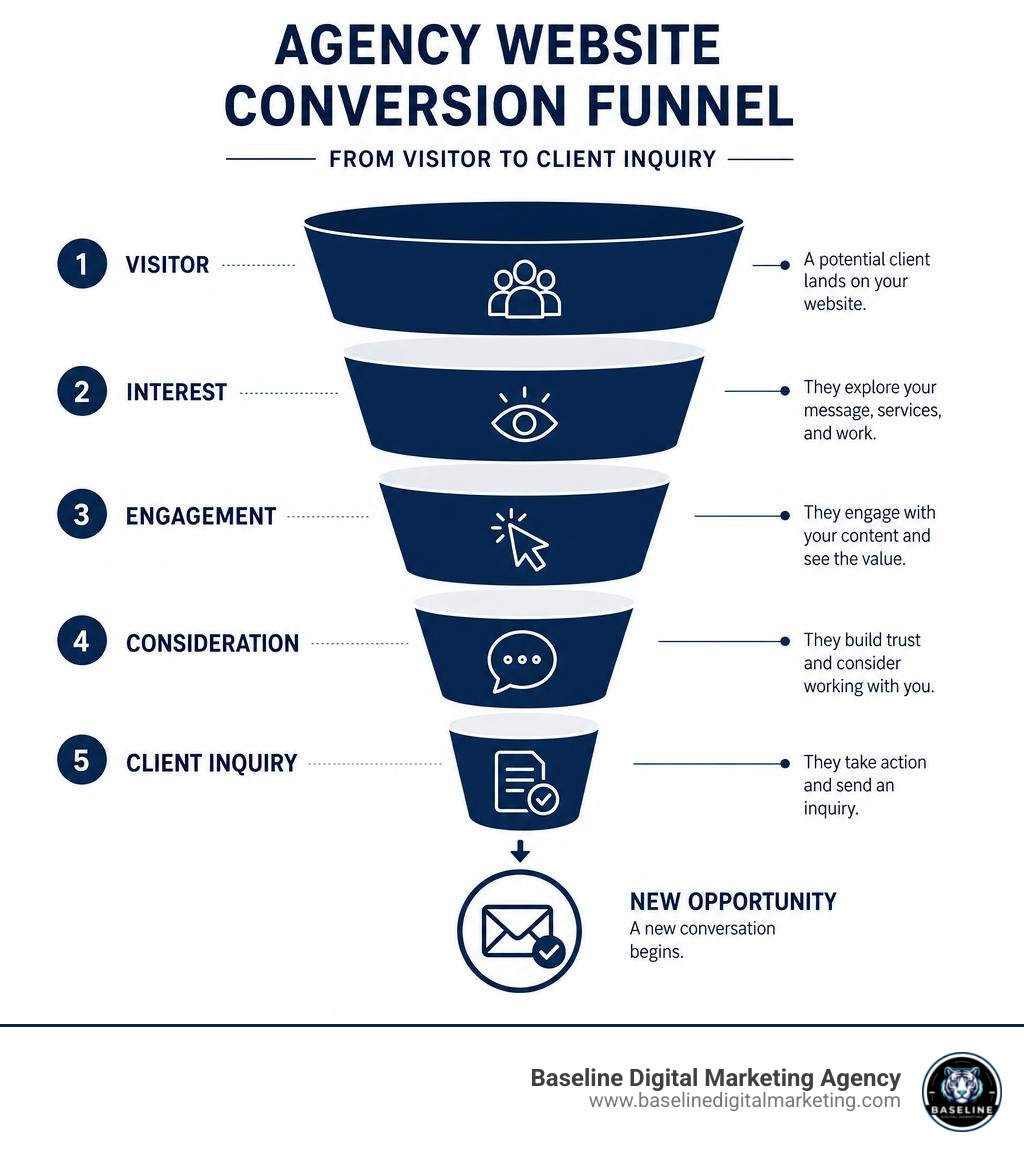
At the end of the day, your creative agency website is a lead generation tool. Your calls-to-action (CTAs) should be highly visible, using contrasting colors and compelling copy (e.g., “Let’s build something together” instead of a boring “Submit”).
Keep your contact forms simple. Asking for too much information upfront kills conversion rates. Stick to the essentials: name, email, company, and a brief project description.
Balancing Creativity with Usability and Conversion
A challenge we face when building a creative agency website is finding the sweet spot between artistic expression and conversion-focused design. An agency site that is too creative can become difficult to navigate, while a site that is too conversion-focused can look generic and uninspiring.
Designing a Creative Agency Website for User Experience
A stellar user experience (UX) is built on a foundation of speed, accessibility, and intuitive navigation. If your beautiful interactive animations cause your site to load slowly, users will bounce before they ever see your portfolio.
- Page Speed: Optimize your video assets, use modern image formats (like WebP), and implement lazy loading to keep load times under two seconds.
- Accessibility: Ensure your high-contrast color choices and typography meet WCAG standards so your site is usable for everyone.
- Mobile Optimization: Over 50% of your traffic will likely come from mobile devices. Your complex desktop interactions must scale down beautifully to touchscreens.
If you are planning to overhaul your current site to improve these performance metrics, explore The Complete Guide to Website Redesign Services for a step-by-step roadmap.
Optimizing Your Creative Agency Website for Client Conversions
To convert casual browsers into paying clients, you must build credibility through social proof. This includes displaying recognizable client logos, case study metrics, and direct client testimonials.
Turning clients into advocates is your highest-leverage growth strategy. Consider these statistics:
- Superfans have a 3x higher lifetime value than standard customers.
- They are 5x more likely to recommend your services to others.
- User-generated content (UGC) and client advocacy drive 7x more engagement than standard brand-authored content.
To make sure you don’t lose these high-value prospects at the finish line, your contact process must be frictionless. Here is a comparison of how form design impacts conversion:
| High-Friction Form (Avoid) | Low-Friction Form (Recommended) |
|---|---|
| Asking for budget ranges with strict minimums | Open-ended budget questions or helpful sliders |
| 10+ required fields (including phone number) | 3 to 4 essential fields |
| Generic “Submit” button | Action-oriented CTA (e.g., “Start Your Project”) |
| No explanation of next steps | Clear note on when they will hear back from you |
Common Mistakes to Avoid When Building Your Site
When designing a creative agency website, it is easy to fall into traps that hurt your search visibility and user retention.
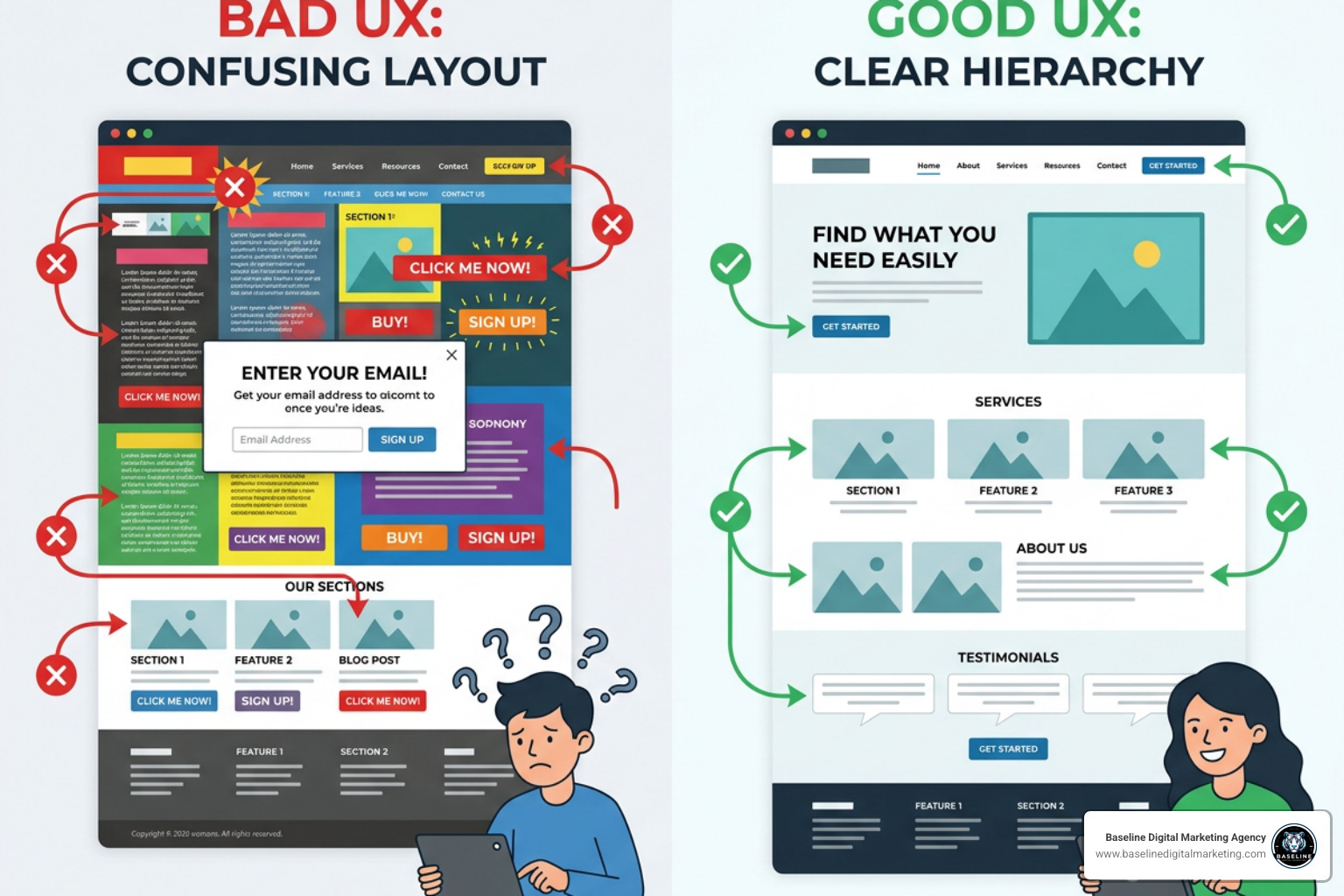
Avoid these common mistakes:
- Over-Designing at the Expense of Usability: Do not let scroll-jacking, heavy 3D elements, or confusing layouts prevent users from finding your contact page.
- Vague Copy and Messaging: Avoid industry jargon. Instead of saying you “architect synergistic brand paradigms,” clearly state that you “design high-converting websites for growing brands.”
- Ignoring SEO: Many creative agencies rely entirely on referral traffic, completely missing out on high-intent organic search traffic. Optimize your metadata, image alt text, and landing page copy for keywords like creative agency website.
- Neglecting the Mobile Experience: A desktop design that looks incredible but breaks on an iPhone is half a website. Always design with a mobile-first mindset.
If you want to see how top-tier agencies successfully navigate these branding and design challenges in competitive niches, take a look at our review of The Best Agencies for Real Estate Branding and Strategy.
Frequently Asked Questions about Agency Websites
How do creative agencies showcase their work effectively?
The most effective way to showcase work is through results-oriented storytelling. Instead of just displaying screenshots, structure your case studies to highlight the client’s original problem, your creative strategy, the execution process, and the measurable business outcome (e.g., “increased conversions by 45%”). Combine this narrative with high-quality video showreels and interactive design elements.
What is the average cost of a website redesign?
The cost of an agency website redesign varies widely based on scope, complexity, and team size. Small, boutique studios might design custom websites starting around $10,000, while mid-sized agencies typically range from $25,000 to $75,000. Large enterprise-scale agencies with deep research, custom development, and brand strategy phases can command project minimums of $150,000 to over $250,000.
How often should an agency redesign its website?
Generally, a creative agency should refresh or redesign its website every 2 to 3 years. Because design trends, web technologies, and user experience standards evolve rapidly, keeping your site updated ensures your agency always looks cutting-edge and performs optimally on modern devices.
Conclusion
Your creative agency website is the ultimate reflection of your capabilities, your culture, and your attention to detail. By balancing bold, immersive design with intuitive user experiences and clear conversion pathways, you can build a site that doesn’t just win design awards—but consistently wins new clients.
At Baseline Digital Marketing Agency, we specialize in helping businesses grow their online presence through custom digital strategies, search engine optimization, AI automation, and high-performance web development.
Ready to transform your digital presence into a client-attracting machine? Get Professional Website Development Services from our team today, and let’s build something remarkable together.