
Your Car Dealership Is Invisible to 30% of Buyers — Here’s Why
Search everywhere optimization for the automotive industry is no longer optional. Right now, 30% of car buyers are asking ChatGPT where to buy their next vehicle. Another wave is searching on TikTok, YouTube, and voice assistants — and never typing a single word into Google.
If your dealership only shows up on Google, you’re invisible everywhere else.
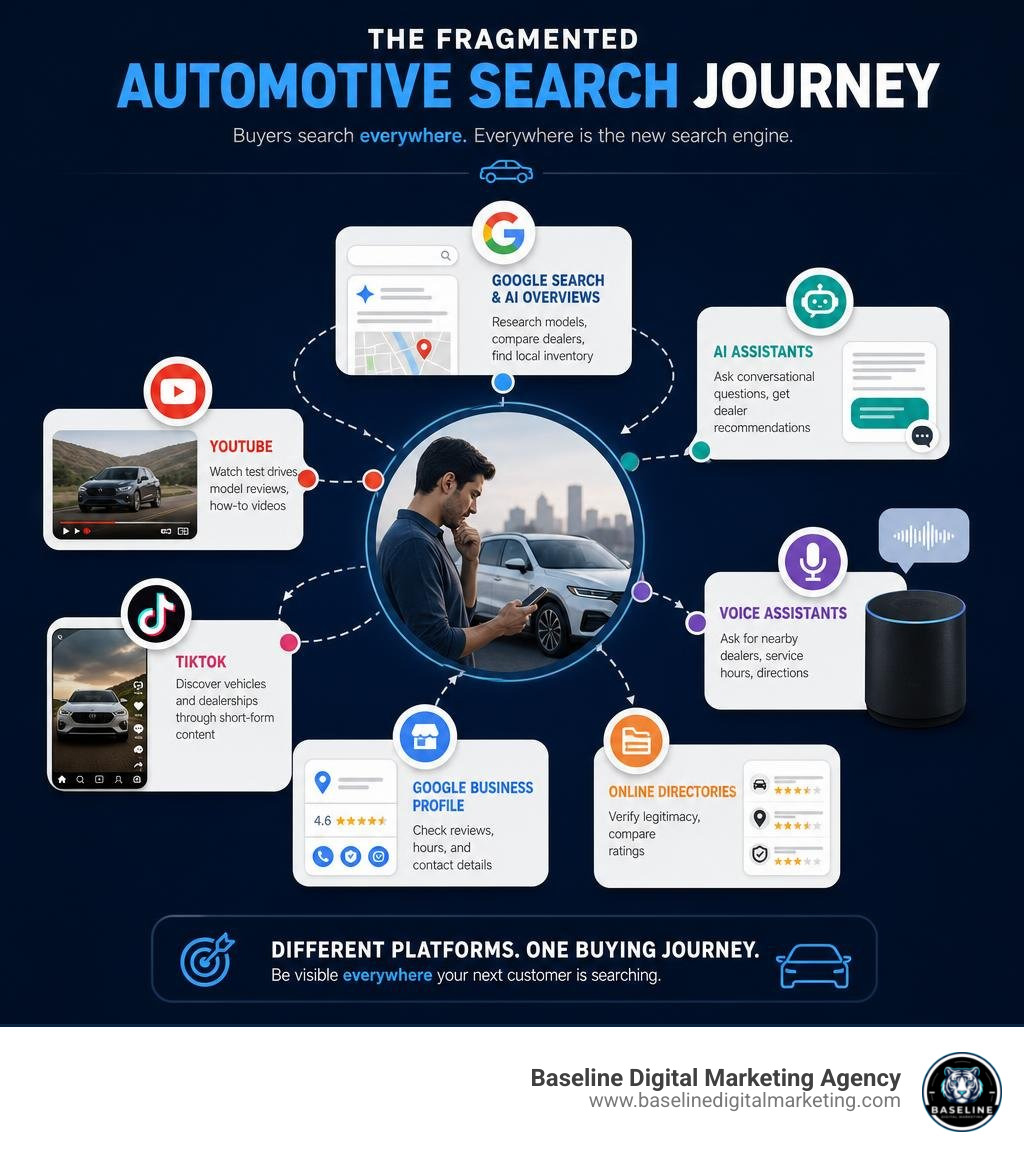
Here’s what Search Everywhere Optimization means for automotive businesses, at a glance:
| Platform | What Buyers Do There |
|---|---|
| Google Search & AI Overviews | Research models, compare dealers, find local inventory |
| ChatGPT / Gemini / Perplexity | Ask conversational questions, get dealer recommendations |
| YouTube | Watch test drives, model reviews, how-to videos |
| TikTok | Discover vehicles and dealerships through short-form content |
| Voice Assistants (Siri, Alexa) | Ask for nearby dealers, service hours, directions |
| Google Business Profile | Check reviews, hours, and contact details |
| Online Directories | Verify legitimacy, compare ratings |
The core idea is simple: every platform with a search bar is now a search engine. Your customers are using all of them — often in the same buying journey.
The car-buying process used to follow a straight line. Today it’s fragmented across dozens of touchpoints before a buyer ever walks through your door. A shopper might discover your brand on TikTok, watch a review on YouTube, ask ChatGPT for a recommendation, and then search Google Maps for directions. Miss any one of those steps, and a competitor takes the sale.
The data backs this up. AI referral traffic to dealership websites has grown 15x year-over-year. Nearly half of all Google searches (48%) now trigger an AI Overview — and 83% of those searches end without a single website click. At the same time, over 82% of mobile users use voice search to find local businesses, and 50% of those visitors show up in person within 24 hours.
This is the new reality of automotive search. And most dealerships aren’t ready for it.
I’m Carlos Alvarez, founder and CEO of Baseline Digital Marketing, and I’ve spent years helping businesses navigate exactly these kinds of digital shifts — applying the same growth strategies behind search everywhere optimization for the automotive industry to help brands build real, compounding visibility across every platform that matters. In this guide, I’ll walk you through everything you need to know to stop losing buyers to dealers who show up everywhere you don’t.
Important Search everywhere optimization for automotive industry terms:
What is Search everywhere optimization for automotive industry?
To win in the modern digital landscape, we must redefine what “search” actually means. It is no longer just about Google’s blue links. Instead, search is a distributed ecosystem.
When we talk about search everywhere optimization for the automotive industry, we are referring to a holistic strategy. It is the process of optimizing your dealership’s or auto company’s digital footprint so that you appear as the top recommendation wherever a customer chooses to look. Whether they are typing a part number into an e-commerce store, asking Siri for “auto repair near me” in Miami, or asking Claude to compare hybrid SUVs, your brand must be the answer.
This approach shifts the focus from chasing specific keywords to building broad brand authority and matching user intent across multiple distinct algorithms. To understand the full scope of this shift, explore our In-Depth Guide to SEO Everywhere Optimization.
Traditional SEO vs. Search everywhere optimization for automotive industry
Traditional SEO is a single-front war. It is built to appease Google’s main search crawler, focusing heavily on matching keywords, securing backlinks, and optimizing meta tags to climb the organic rankings.
Search Everywhere Optimization, on the other hand, is a multi-platform campaign. It recognizes that social media platforms like TikTok and YouTube, AI chatbots like ChatGPT, and localized directories all run on unique native search algorithms.
| Feature | Traditional SEO | Search Everywhere Optimization |
|---|---|---|
| Primary Target | Google and Bing search algorithms | Native search bars on TikTok, YouTube, AI Engines, Voice, and Maps |
| Primary Metric | Keyword rankings, website organic traffic | Brand mentions, video views, AI citations, and local store visits |
| Content Format | Text-heavy blog posts, landing pages, and category links | Videos, Q&As, clean data feeds, structured schema, and transcripts |
| Key Authority Signal | Backlinks and Domain Authority | Distributed multi-platform presence, reviews, and structured listings |
| User Intent Focus | Informational, navigational, transactional queries | Conversational questions, visual exploration, and immediate local needs |
By optimizing for all of these platforms simultaneously, we build an interconnected web of authority. If you want to make sure your baseline technical performance is healthy before expanding to other platforms, we highly recommend reading The Definitive Guide to SEO Audit to ensure your site is completely crawlable.
How Search Everywhere Impacts the Modern Car-Buying Journey
The modern car-buying journey is highly fragmented and rarely follows a straight line. According to research from Michigan Tech, modern consumers use social media, forums, and directories as primary search engines. You can read more about this shift in their overview on What is Search Everywhere Optimization? .
Because of zero-click searches—where Google or an AI tool answers the user’s question directly on the search page—fewer shoppers are clicking through to traditional website homepages. Instead, they interact with your brand across multiple micro-touchpoints.
A buyer might start by asking ChatGPT: “What’s the best family-friendly SUV under $40,000?” The AI reviews various online articles and recommends a model. The buyer then heads to YouTube to watch a video walk-around, jumps to TikTok to see real-owner reviews, and finally uses voice search to find a dealership near them in South Florida. If your dealership isn’t visible on each of these platforms, you are effectively dropping out of the running before the customer even makes direct contact.
Why AI-Driven Search and GEO are Critical for Automotive Brands
We have officially entered the era of Generative Engine Optimization (GEO). Search engines are no longer just indexing the web; they are reading it, synthesizing it, and answering complex conversational questions in real-time.
To stay competitive, dealerships must adapt. For a deep dive into how artificial intelligence is changing the search landscape, read our guide on How Generative AI is Rewriting the Rules of SEO.
How AI Search Influences the Early Stages of the Buying Journey
AI search is reshaping the earliest stages of the vehicle-buying journey. While traditional search is still heavily used for direct transactional queries like “Ford F-150 for sale near Miami”, AI assistants excel at broad, research-style questions.
A user might ask an AI assistant: “Which SUV is easiest to fit three car seats in?” or “What are the common maintenance issues with a used 2021 Silverado?”
Even though AI search represents a relatively small slice of overall dealership website traffic today, the visitors referred by AI behave like deep-funnel shoppers. They are not casual top-of-funnel browsers; they are highly informed, close to taking action, and convert at exceptionally high rates.
As outlined in AI Search Optimization for Car Dealerships: The Complete GEO Guide , early GEO adopters are seeing significant increases in high-intent leads because they answer these conversational queries directly.
Optimizing for AI Citations and LLM Recommendations
To get cited by Large Language Models (LLMs) like ChatGPT, Gemini, and Claude, your digital content must be structured so that AI engines can easily read and trust it.
Here are the key technical and content strategies we use to earn AI citations:
- Configure Your Robots.txt: Ensure your site doesn’t block AI crawlers like
GPTBot,OAI-SearchBot, andPerplexityBot. - Create an LLMs.txt File: This is a clean, text-only file (placed at
yourdomain.com/llms.txt) that provides a structured, easily digestible summary of your business, inventory, and services specifically for AI models. - Focus on the First 30% of Your Pages: Studies show that 44% of ChatGPT citations come from the first 30% of a page’s content. Keep your most important answers, facts, and unique selling points right at the top.
- Build Distributed Authority: AI models build trust by cross-referencing information across multiple platforms. If your dealership is mentioned on your website, cited in local news listicles, reviewed on YouTube, and has a complete Google Business Profile, the AI is far more likely to recommend you.
To understand how these AI systems synthesize information and why they choose to cite specific dealers over others, you can read The AI revolution in search (and why it matters to car dealers) .
Key Platforms Beyond Google for Automotive Search Visibility
If you want to dominate your local market, you have to look beyond Google. Your prospective buyers are spending hours on alternative platforms that feature highly sophisticated internal search engines.

Leveraging YouTube and TikTok for Visual Automotive Search
YouTube is the second largest search engine on earth, and TikTok has rapidly become the go-to search platform for younger demographics. Car buyers want to see the vehicles they are considering.
To capture this visual search traffic, we must optimize our video content:
- Video SEO and Transcripts: AI crawlers cannot watch videos like humans, but they can read transcripts. Always upload clean, accurate closed captions and written transcripts for your YouTube and TikTok videos.
- Local Hashtags and Titles: Use location-specific terms in your video titles and descriptions (e.g., “2026 Honda Civic Walkaround Miami”).
- Leverage Creator Content: Partner with local Miami influencers or encourage your sales team to create authentic, raw walk-around videos. Authentic customer stories and real-world footage establish incredible trust.
Optimizing for Voice Search and Conversational AI Assistants
With over 82% of mobile users using voice search to find local businesses, optimizing for Siri, Alexa, and Google Assistant is critical. Voice queries are fundamentally different from typed searches; they are longer, more conversational, and typically phrased as complete questions.
While a typed search might be “car repair Miami”, a voice search is more likely to be: “Where is the closest auto repair shop open now near North Miami?”
To optimize for voice search, we focus on:
- Conversational long-tail keywords that mimic real human speech.
- FAQ sections that directly answer “Who,” “What,” “Where,” “Why,” and “How” questions.
- Ultra-localized content that targets specific neighborhoods.
To refine your local presence for these voice queries, check out A Practical Guide to Local SEO.
Structuring Automotive Catalog Data and Fitment for Maximum Discoverability
For auto parts retailers, distributors, and dealerships managing massive parts catalogs, search optimization is a completely different beast. If a customer cannot easily find the exact part that fits their specific vehicle, they will leave your site immediately.

Best Practices for Search everywhere optimization for automotive industry
Automotive e-commerce catalogs are incredibly complex, often managing hundreds of thousands of SKUs. To make these parts discoverable to both human shoppers and AI search engines, we must adhere to global industry standards:
- ACES (Aftermarket Catalog Exchange Standard): Standardizes vehicle application and fitment data (year, make, model, trim, engine).
- PIES (Product Information Exchange Standard): Standardizes product attributes (part numbers, dimensions, weight, brand, images).
Standardizing your data according to ACES and PIES is critical. It allows search engines to natively ingest your catalog and display accurate compatibility information. For a detailed look at fixing these catalog discoverability issues, read How To Fix Poor Product Discovery in Automotive Retail .
Additionally, deploying modern search technology can transform your e-commerce conversion rates. For instance, you can learn about modern search solutions in Algolia Introduces New Intelligent Auto Parts Solution or explore specialized backend merchandising strategies in Auto Parts Search, Catalog, and Merchandising .
Solving the Fitment and Interchange Data Challenge
One of the biggest friction points in automotive e-commerce is the “fitment problem.” Many parts can fit up to 100,000 vehicle variations. If a search engine returns a wall of generic results, the shopper will bounce.
To solve this, we implement:
- Fitment-Aware Search: The search engine must carry the vehicle context (e.g., “2020 Honda Civic”) throughout the entire shopping session, automatically filtering out incompatible parts.
- SKU and Cross-Reference Intelligence: Your search tool must understand that different brands might use completely different part numbers for the exact same spark plug or brake pad, resolving these cross-references natively.
- Edge-Rendered Instant Filters: Large dealer groups manage thousands of vehicles across multiple locations. Using high-performance search APIs allows for sub-second filter responses and instant faceted search. You can see how large dealer groups scale this infrastructure in How Touchless powers instant, scalable vehicle search for large dealer groups | Meilisearch .
Technical SEO, Schema Markup, and Local Optimization
No matter how great your content is, it will fail to rank across AI engines and traditional search platforms if your technical foundation is weak.
Implementing Schema Markup and Structured Data
Schema markup is the translator that helps search engines and AI models understand the exact context of your website’s content. For the automotive industry, we use specialized schemas to feed search engines structured, clean data:
- AutoDealer Schema: Defines your business name, address, phone number, operating hours, and geographic area.
- FAQPage Schema: Outlines common questions and answers, making your site 2.8 times more likely to be cited by AI platforms.
- Product Schema: Highlights specific vehicle details, price, availability, and fitment compatibility.
To ensure your structured data and internal links are working together to maximize your search real estate, we recommend performing an Internal Linking Audit: How to Find Hidden Ranking Opportunities.
For a complete step-by-step technical checklist, refer to our Detailed SEO Audit Guide: Stop Guessing and Start Ranking.
Local SEO and Google Business Profile Optimization
For physical dealerships and service centers in Miami, local optimization is where the rubber meets the road. If your local citations are inconsistent, search algorithms will lose trust in your business location and drop your rankings.
- NAP Consistency: Ensure your Name, Address, and Phone number are identical across Google Business Profile, Bing Places, Apple Maps, and hundreds of local directories.
- Review Management: Regularly generate and respond to reviews. When responding, use specific, natural language (e.g., “Thank you for bringing your Ford Explorer to our Miami service center for an oil change!”). This adds rich, localized context that AI crawlers love to index.
- Optimize Local Listings: For car dealerships looking to dominate the local Miami landscape, working with a specialized agency is key. Implementing localized automotive campaigns ensures your business ranks at the top of local map packs and voice search results.
To explore our full suite of optimization capabilities, check out our A-Z Guide to SEO Services and learn how to build authority in 3 Contextual Link Building Strategies That Will Make Google Love You.
Frequently Asked Questions about Automotive Search
What is the difference between traditional SEO and Search Everywhere Optimization?
Traditional SEO focuses almost exclusively on optimizing your website to rank higher in Google’s organic search results. Search Everywhere Optimization optimizes your brand’s visibility across all platforms where consumers search, including TikTok, YouTube, AI engines (like ChatGPT), voice assistants, and local map directories.
How does Generative Engine Optimization (GEO) help car dealerships?
GEO helps car dealerships by structuring their website content, local listings, and data feeds so they are easily understood and trusted by AI models. When a user asks an AI assistant for a local dealership recommendation or vehicle comparison, GEO strategies ensure your dealership is named, described, and cited as the trusted source.
Which platforms are most important for automotive search besides Google?
The most critical platforms beyond Google are YouTube (for visual research and test drives), TikTok (for short-form discovery), ChatGPT/Gemini (for conversational research), and Google Maps/Apple Maps (for immediate local navigational searches).
Conclusion
The era of relying solely on traditional Google search to drive traffic to your car dealership is over. In June 2026, car buyers are exploring their options across a highly fragmented, multi-platform digital world. To keep your dealership from being left in the dust, you must optimize your brand to be found everywhere.
Building a comprehensive, multi-platform search presence requires technical expertise, clean data structures, and a forward-thinking digital strategy. At Baseline Digital Marketing Agency, we specialize in developing the advanced, multi-channel strategies that modern automotive brands need to grow their online presence, secure AI citations, and drive deep-funnel leads straight to their showrooms.
Ready to dominate every search bar that matters? Let’s build a strategy that puts your dealership in front of buyers, no matter where they search.
- Explore our Search Everywhere Optimization Services
- Contact us today at Baseline Digital Marketing to schedule your custom digital audit!